Growth Strategy
How Should You Choose an Amazon Ads Agency?
How to choose an Amazon Ads agency: what it manages, ACOS, ROAS and TACOS formulas, a worked profitability example, the first 90 days and red flags.
Brilliant Brains · · Updated · 11 min read
An Amazon Ads agency plans, builds and manages your sponsored ads on Amazon, and it should be judged on the profit those ads add to your business, not on the spend it manages or a headline ACOS. Before you sign, check that the agency sets targets from your unit economics, explains how it will structure and optimise campaigns, connects advertising to listing quality and stock, and reports on total sales and margin as well as ad metrics.
What an Amazon Ads agency manages
Amazon's sponsored ads include Sponsored Products and Sponsored Brands, both charged per click, alongside display and streaming TV formats. An agency usually covers the areas below.
| Area | What the agency does | What to ask |
|---|---|---|
| Account audit | Reviews structure, search terms, wasted spend and listing readiness | What did you find in comparable accounts? |
| Campaign structure | Separates automatic, keyword and product targeting, and brand from non-brand | How will our campaigns be organised and named? |
| Targeting | Moves converting search terms into manual campaigns and adds negatives | How often do you review search terms? |
| Bids and budgets | Sets bids by target and placement and manages daily budgets | How do bids connect to our margin targets? |
| Sponsored Brands creative | Headlines, images, video and Store pages | Who produces the creative assets? |
| Listing readiness | Flags issues with titles, images, bullet points, A+ content, reviews and stock | Can you edit listings, or only advise? |
| Reporting | Spend, sales, ACOS, ROAS, TACOS and margin after advertising | Will we see profit, not just ad metrics? |
ACOS, ROAS and TACOS explained
ACOS (advertising cost of sales) = ad spend ÷ ad-attributed sales × 100. In Amazon's own example, spending $50 to generate $100 in ad sales gives an ACOS of 50%.
ROAS (return on ad spend) = ad-attributed sales ÷ ad spend. Amazon describes it as the inverse of ACOS, so an ACOS of 50% is the same as a ROAS of 2.
TACOS (total advertising cost of sales) = ad spend ÷ total sales, advertised and organic, × 100. TACOS is an industry convention rather than a metric defined in Amazon's ACOS guide, so agree the exact definition and data source with your agency before using it as a target.
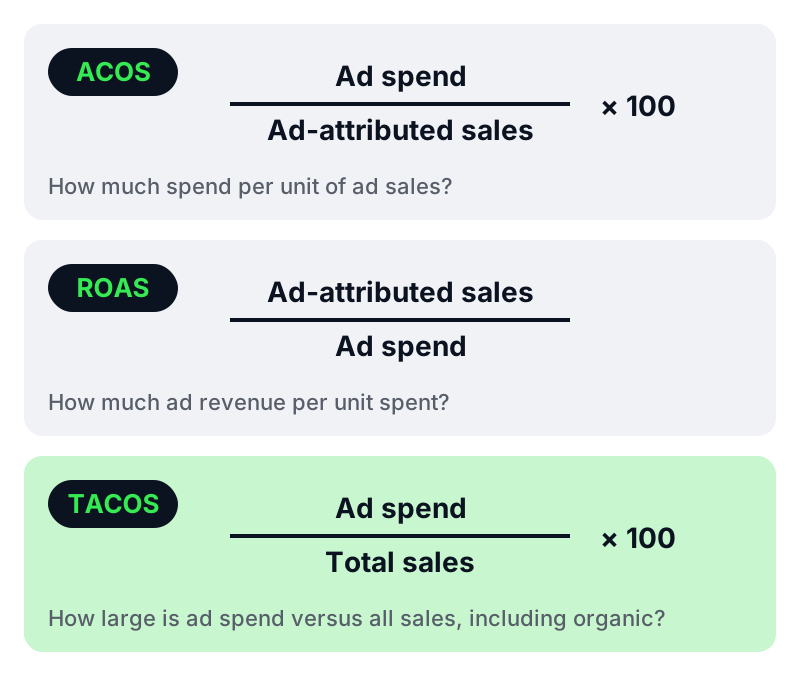
| Metric | Formula | Question it answers | Limitation |
|---|---|---|---|
| ACOS | Ad spend ÷ ad-attributed sales × 100 | How much ad spend per unit of ad-attributed sales? | Ignores organic sales and non-ad costs |
| ROAS | Ad-attributed sales ÷ ad spend | How much ad-attributed revenue per unit spent? | Same attribution limits as ACOS |
| TACOS | Ad spend ÷ total sales × 100 | How large is ad spend relative to the whole business? | Also moves with organic sales, pricing and stock |
| Break-even ACOS | Margin before advertising ÷ selling price × 100 | At what ACOS do ads leave zero profit? | Needs accurate unit costs |
Ad-attributed sales are counted using Amazon's attribution rules. They show sales associated with ads, which is not the same as proving the ads caused every one of those sales.
Seller economics: setting targets from your margins
Amazon's guidance is clear: to stay profitable, ACOS needs to be lower than your profit margin, otherwise you spend more on ads than you earn. To use that rule, calculate your margin before advertising for each product from these inputs:
- Selling price, excluding GST or VAT.
- Landed product cost.
- Amazon referral, closing and fulfilment fees for your category and fulfilment method.
- Returns, damages and other variable costs.
Illustrative profitability calculation
The figures below are hypothetical. They show the method only and are not a client result or an industry benchmark.
| Line | Amount (₹) | Note |
|---|---|---|
| Selling price, excluding GST | 1,000 | Hypothetical product |
| Landed product cost | 350 | Hypothetical |
| Amazon fees | 250 | Check the current fee schedule for your category |
| Returns and other variable costs | 50 | Hypothetical |
| Margin before advertising | 350 | 35% of selling price |
| Break-even ACOS | 35% | Ad spend equals margin |
| Target ACOS for a 10% profit after ads | 25% | 35% margin minus a 10-point profit target |
| Scenario | Ad spend (₹) | Ad-attributed sales (₹) | ACOS | ROAS | Profit on ad-attributed sales (₹) |
|---|---|---|---|---|---|
| A | 20,000 | 1,00,000 | 20% | 5.0 | 15,000 |
| B | 30,000 | 1,00,000 | 30% | 3.3 | 5,000 |
| C | 40,000 | 1,00,000 | 40% | 2.5 | Loss of 5,000 |
Profit on ad-attributed sales here is 35% of ad-attributed sales minus ad spend. Scenario C still looks respectable on ROAS, yet it loses money on every ad-attributed sale. That is why targets should come from your margin. A product launch can deliberately run above break-even for a limited period, but only if you agree that trade-off, its budget and its end date in advance.
If scenario A sits within total monthly sales of ₹2,50,000, including organic sales, TACOS is ₹20,000 ÷ ₹2,50,000, or 8%. Tracking that figure over time shows whether advertising is growing the business or simply replacing sales you would have made anyway.
Listing quality comes before scaling
Ads send shoppers to your product detail page, and the page decides whether they buy. Amazon's Sponsored Products guidance recommends checking retail readiness before advertising, including:
- Holding the featured offer, with a competitive price and products in stock.
- A clear title of about 60 characters.
- At least four zoomable images and at least three bullet points.
- Advertising products with five or more reviews and a rating of 3.5 stars or higher.
- A+ content where you are a vendor or a Brand Registry seller.
- Prime eligibility through Fulfilment by Amazon where it suits your operations.
An agency that does not ask about stock levels, pricing and reviews before increasing bids is optimising the wrong thing.
Advertising and organic ranking
Advertising can bring additional sales, but Amazon does not state that ad spend improves a product's organic ranking, and no agency can promise organic rank gains from ads. Use TACOS and organic sales trends to judge whether the business as a whole is growing, rather than relying on claims about ranking effects.
The first 90 days
Amazon's own guidance is to check metrics at least twice a week in the first week, optimise over the first 30 days and keep campaigns always on. Treat the early weeks as a learning period, not a verdict.
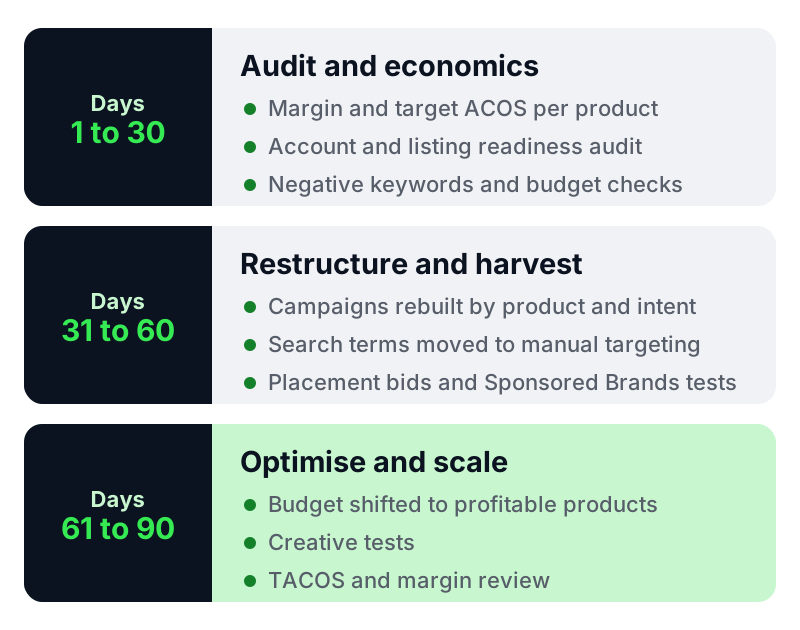
| Phase | Focus | Typical deliverables |
|---|---|---|
| Days 1 to 30 | Audit and economics | Margin and target ACOS per product, account audit, listing readiness review, restructure plan, negative keyword clean-up, budget checks |
| Days 31 to 60 | Restructure and harvest | Campaigns rebuilt by product and intent, converting search terms moved into manual campaigns, placement bid changes, Sponsored Brands tests |
| Days 61 to 90 | Optimise and scale | Budget shifted towards profitable products, creative tests, TACOS and margin review, plan for the next quarter |
Reporting you should receive
| Report element | Frequency | Why it matters |
|---|---|---|
| Spend, ad sales, ACOS and ROAS by campaign and product | Weekly | Day-to-day control |
| Search terms added as keywords and as negatives | Weekly or fortnightly | Shows the optimisation work being done |
| TACOS and total sales trend | Monthly | Whether ads grow the whole business |
| Margin after advertising by product | Monthly | Profit, not just revenue |
| Listing, stock and pricing issues found | As they occur | Problems that advertising cannot fix |
| Tests run and next actions | Monthly | Accountability |
How to choose: questions, red flags and pricing
Questions to ask before signing
- How will you set ACOS targets from our product margins?
- Which brands in our category or price range have you managed, and can we speak to one of them?
- How will you structure our campaigns, and why?
- How often will you review search terms and adjust bids?
- What will you need from us on listings, stock and creative?
- What will we see in weekly and monthly reports?
- Are you part of the Amazon Ads Partner Network, and which badges do you hold?
- How do you charge, and what is the notice period?
Amazon advises treating partner badges and awards as supporting data points rather than the only factor, and suggests requesting proposals from five to six potential agency partners.
Red flags
- A fixed ACOS promise before the agency has seen your margins.
- Guarantees of organic ranking or sales.
- Reporting that never shows profit or TACOS.
- An agency that wants to own your Seller Central, Vendor Central or advertising account instead of receiving user access.
- Long lock-in contracts with no review point.
- No routine for search terms and negative keywords.
Pricing models
| Model | How it works | Watch for |
|---|---|---|
| Percentage of ad spend | The fee rises with spend | An incentive to raise spend regardless of profit |
| Flat monthly fee | A fixed fee for a defined scope | Scope limits as the account grows |
| Hybrid | A base fee plus a percentage or performance element | How performance is defined and measured |
| Performance-based | The fee is linked to agreed outcomes | Definitions, attribution and caps |
Where Amazon Ads fit in your growth mix
Many brands sell both on Amazon and through their own website, and Amazon Ads work best when pricing, creative and measurement are planned across both. Our performance marketing team manages paid media against profit-led targets, and for D2C and e-commerce brands we connect marketplace advertising with website conversion and retention. For a deeper look at what drives return on ad spend across channels, read what actually moves ROAS. If your own store runs on Shopify, our guide to choosing a Shopify SEO agency covers the organic side.
Want a second opinion on your Amazon numbers? Request a marketplace advertising profitability review. We will map your margins to target ACOS, review campaign structure and search terms, and highlight where spend is not earning a return.
Conclusion
Choose an Amazon Ads agency that starts from your margins, explains its structure and optimisation routine, treats listing quality and stock as part of the job, and reports on profit and TACOS as well as ACOS. Be wary of anyone who promises a fixed ACOS or organic ranking gains before they have seen your numbers.
Frequently Asked Questions
What does an Amazon Ads agency do?
It plans and manages your sponsored ads on Amazon, including campaign structure, keyword and product targeting, bids, budgets, Sponsored Brands creative and reporting. Good agencies also flag listing, pricing and stock issues that limit ad performance.
What is a good ACOS on Amazon?
A good ACOS is one below your margin before advertising, adjusted for your goal. If a product earns a 35% margin before ads, an ACOS under 35% is profitable on ad-attributed sales. There is no universal benchmark across categories.
What is the difference between ACOS and TACOS?
ACOS compares ad spend with ad-attributed sales. TACOS compares ad spend with total sales, including organic sales. ACOS shows campaign efficiency, while TACOS shows how dependent the business is on advertising over time.
How much does an Amazon Ads agency cost?
Agencies usually charge a percentage of ad spend, a flat monthly fee, a hybrid of the two or a performance-based fee. Compare the scope, the seniority of the team and how fees behave as spend grows, not just the headline rate.
How long before Amazon Ads results stabilise?
Expect the first month to focus on audit and restructuring. Amazon recommends close monitoring in the first week and optimising over the first 30 days. Results become more dependable as search-term and conversion data builds, which can take several weeks to a few months.
Do Amazon ads improve organic ranking?
Amazon does not state that advertising improves organic ranking, so no agency should guarantee it. Ads can add sales, and you can judge their wider effect by tracking TACOS and organic sales over time.