Growth Strategy
Dental Digital Marketing: A Patient Enquiry Guide for Clinics
Dental digital marketing for clinics: local SEO, Google Business Profile, treatment pages, paid search, reviews and tracking cost per booked appointment.
Brilliant Brains · · Updated · 11 min read
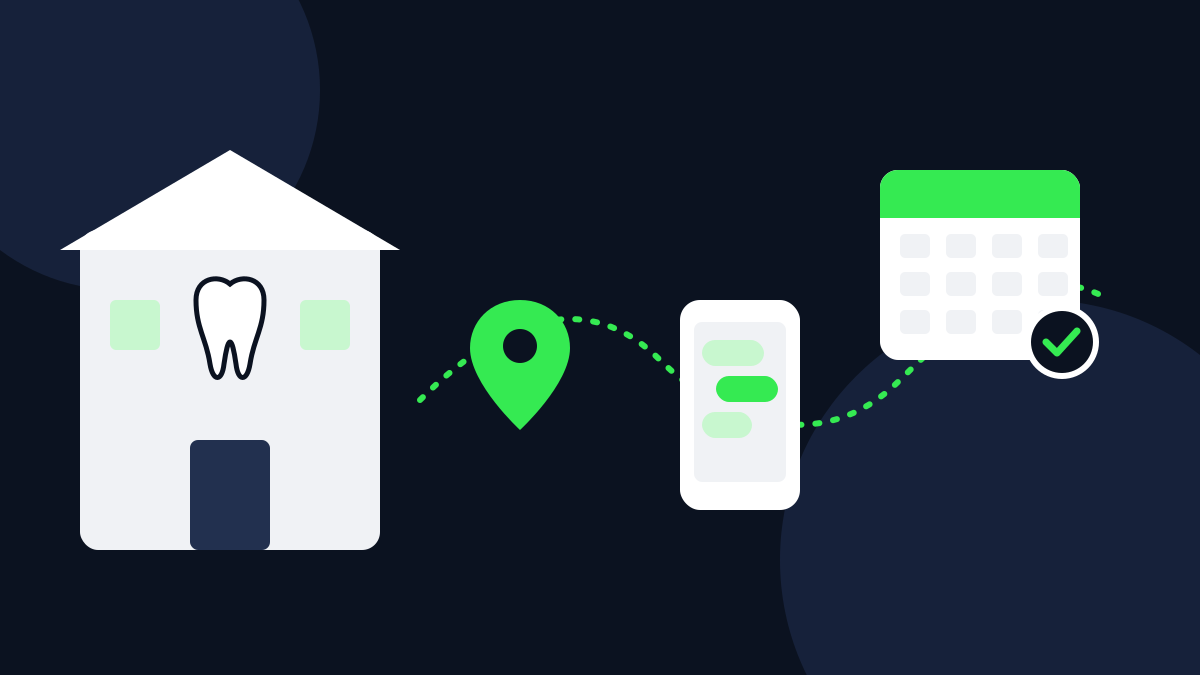
Dental digital marketing is the work of making a clinic easy to find, easy to trust and easy to book online. For most clinics the sequence that matters is: appear in local search and maps, give each treatment a clear page, make enquiring simple on a phone, respond quickly, and measure how many enquiries become attended appointments. This guide covers each stage, with the advertising and privacy checkpoints clinics in India, the UK and the UAE should review before spending on ads.
The patient acquisition funnel for dental clinics
Think of patient acquisition as six stages. Each stage has its own job, its own channels and its own metric, which makes it far easier to see where enquiries are being lost.
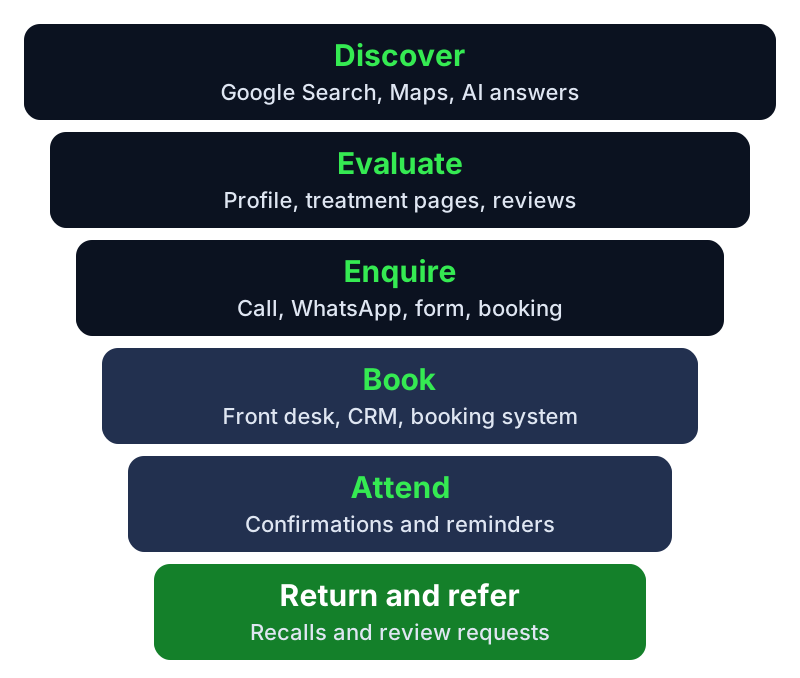
| Stage | Main channels | What to measure |
|---|---|---|
| Discover | Google Search, Maps and AI answers | Impressions, map views and searches for your clinic |
| Evaluate | Google Business Profile, treatment pages and reviews | Profile actions, page engagement, review count and rating |
| Enquire | Calls, WhatsApp, forms and online booking | Enquiries by channel and treatment |
| Book | Front desk, CRM and booking system | Enquiry-to-booking rate and response time |
| Attend | Reminders and confirmations | Show rate and cancellations |
| Return and refer | Recall messages and review requests | Repeat visits and new reviews |
Local SEO and Google Business Profile
Google says local results are based mainly on relevance, distance and prominence, and that there is no way to request or pay for a better local ranking. Relevance depends on complete and accurate profile information, while prominence draws on signals such as links to your website and your review count and ratings.
- Choose the most accurate primary category, then add relevant secondary categories.
- Keep the clinic name, address and phone number identical everywhere they appear online.
- Add opening hours, holiday hours, services, an appointment link and accessibility attributes.
- Upload real photographs of the clinic, team and equipment rather than stock images.
- Post updates about services, timings and announcements without making clinical claims.
- Answer questions on the profile and respond to every review.
Clinics with several branches need one verified profile per location and a matching location page for each branch on the website.
Service pages that answer patient questions
Each core treatment deserves its own page, for example root canal treatment, dental implants, braces and aligners, scaling and cleaning, and children's dentistry. A strong service page explains what the treatment involves, who it may suit, the typical appointment steps, aftercare and how to book. Keep it factual, and have the treating dentist review it before publishing.
| Section | What to include | What to avoid |
|---|---|---|
| Treatment overview | A plain-language explanation reviewed by a dentist | Promised outcomes or "painless" guarantees |
| Suitability | A note that suitability depends on a clinical assessment | Implying the treatment suits everyone |
| Process and duration | Typical number of visits and what happens at each | Timelines presented as guaranteed |
| Fees | A starting fee or fee range, if your clinic publishes fees | Hidden conditions or misleading starting prices |
| Clinicians | Names, recognised qualifications and registration numbers where required | Specialist titles that are not formally recognised |
| Booking | Call, WhatsApp and online booking options | Long forms that ask for medical history before booking |
In India, the revised Dentists (Code of Ethics) Regulations permit factual clinic websites that describe treatment facilities and fees, but treat claims of superiority and non-factual statements as unethical. In the UK, the General Dental Council's guidance on advertising expects clinician websites to show qualifications and GDC registration numbers, and warns against claims that create unjustified expectations about results.
Paid search for dental clinics
Google Ads is most useful when the diary has gaps or when a new clinic is waiting for organic visibility to build. Keep campaigns tight: separate high-intent treatment searches from general ones, target a realistic catchment around the clinic, and add negative keywords for job seekers, dental courses and free treatment searches.
- Send each ad group to the matching treatment page, not the homepage.
- Use call assets and count qualified calls as conversions.
- Schedule ads for the hours when someone can answer the phone.
- Review the search terms report weekly in the first months.
- Optimise towards booked appointments by importing offline conversions where your CRM supports it.
Health is a sensitive category in Google's personalised advertising policy, which restricts advertisers from using their own audience lists, such as customer match, when promoting products or services in sensitive health categories, including invasive medical procedures. Check whether your treatments fall under the policy before building remarketing or customer-list audiences.
Reviews and reputation
Reviews influence both local prominence and a patient's decision to enquire. Google's policy on fake engagement prohibits offering incentives for reviews, selectively asking only satisfied customers for reviews and discouraging negative reviews.
- Ask every patient in the same way, for example with a message after their appointment.
- Never offer discounts, gifts or free treatment in exchange for a review.
- Reply to all reviews, thanking positive reviewers and inviting anyone with concerns to talk to the clinic directly.
- Never confirm that someone is a patient or mention treatment details in a public reply.
- Track review volume and average rating by location every month.
Conversion optimisation: turning visits into enquiries
Most patients search on a phone, so test every important page on a mobile device. Simple changes often matter most.
- A tap-to-call button and a WhatsApp option visible on every page.
- Opening hours, location and parking or transport details near the top of the page.
- A short enquiry form: name, phone number, treatment of interest and preferred time.
- Fees or fee ranges where your clinic publishes them.
- Real clinic photographs and clinician profiles.
- A response promise you can keep, such as a reply within working hours.
Speed of response matters as much as the page itself. Measure the time between an enquiry arriving and the first reply, and close that gap before increasing ad spend.
Enquiry tracking and booked-appointment measurement
Clicks and impressions do not fill a dental chair. The metric that connects marketing to the diary is cost per booked appointment, and ideally cost per attended appointment.
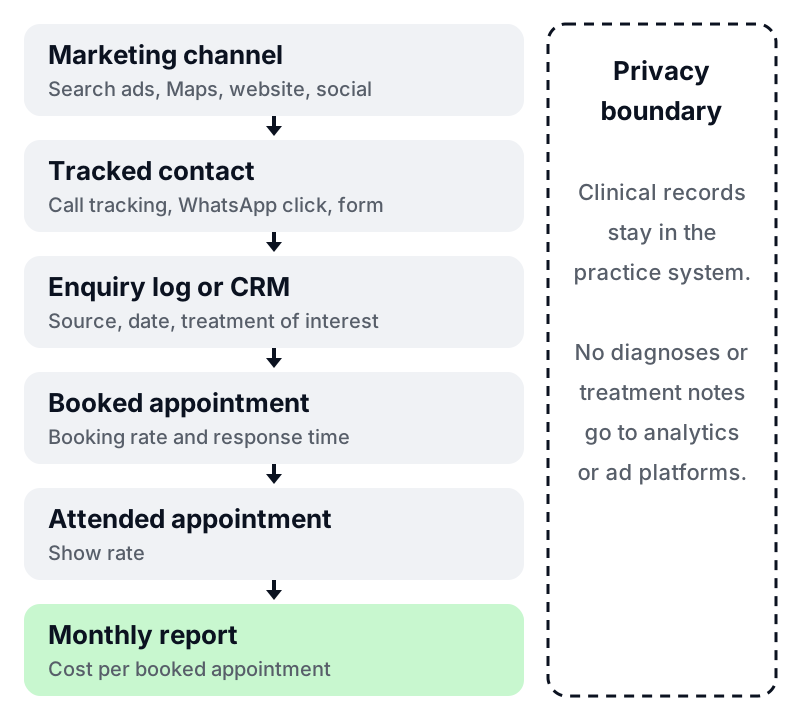
| Metric | Formula | What it tells you |
|---|---|---|
| Enquiry rate | Enquiries ÷ website sessions | How well pages turn visitors into enquiries |
| Booking rate | Booked appointments ÷ enquiries | How well the front desk converts enquiries |
| Show rate | Attended appointments ÷ booked appointments | How well confirmations and reminders work |
| Cost per enquiry | Channel spend ÷ enquiries from that channel | Channel efficiency at the top of the funnel |
| Cost per booked appointment | Channel spend ÷ booked appointments from that channel | The core acquisition metric |
Illustrative example, not a client result: a clinic spends ₹60,000 on search ads in a month, receives 120 enquiries and books 48 appointments. Its cost per enquiry is ₹500 and its cost per booked appointment is ₹1,250. If 40 of those patients attend, the cost per attended appointment is ₹1,500.
Keep tracking data separate from clinical records. Record the channel, date and treatment of interest in your enquiry log or CRM, but do not send diagnoses, treatment notes or other health information to analytics or advertising platforms. In the UK, the ICO confirms that data concerning health is special category data under UK GDPR, and in India the Digital Personal Data Protection Act, 2023 governs digital personal data. Take professional advice on your obligations.
Compliance checkpoints before you advertise
| Market | Rules to check | Practical implication |
|---|---|---|
| India | Dentists (Code of Ethics) Regulations, as revised in 2014 | Advertising must maintain decorum, websites must be factual, and boasting of cures or claiming superiority is unethical |
| United Kingdom | General Dental Council guidance on advertising | Show qualifications and GDC numbers, avoid misleading claims and unjustified expectations |
| United Arab Emirates | Federal and emirate health authority rules on healthcare advertising | Healthcare advertising, including on social media, can require a licence or prior approval |
| All markets | Google and Meta advertising policies | Health-related targeting and remarketing restrictions apply |
This is a summary, not legal advice. Check the current rules with your dental council or health regulator before launching campaigns.
A practical setup order
- Complete and verify a Google Business Profile for every location.
- Fix mobile speed, contact buttons and booking paths on the website.
- Publish or improve one page for each core treatment.
- Set up call, WhatsApp and form tracking, plus a simple enquiry log or CRM.
- Start a consistent review request routine.
- Launch tightly targeted search campaigns once tracking works.
- Review cost per booked appointment every month and reallocate budget.
How Brilliant Brains helps clinics
We work with healthcare and clinic brands on local and AI search visibility through our SEO, AEO and GEO services, on paid patient acquisition through performance marketing, and on enquiry handling through AI Patient Flow, which brings acquisition, CRM, follow-ups and reputation into one system.
Want to know where your clinic is losing enquiries? Request a clinic patient acquisition review. We will check your Google Business Profile, treatment pages, tracking setup and enquiry handling, then share a prioritised action list.
Conclusion
Dental marketing works best as one connected system: visible in local search, clear about each treatment, easy to contact, quick to respond and measured on booked appointments. Build the foundations first, stay within your regulator's rules, and scale paid spend only once you know what it costs to fill a chair.
Frequently Asked Questions
What is dental digital marketing?
It is the use of local search, Google Business Profile, a clinic website, paid search, reviews and follow-up systems to help prospective patients find a clinic, enquire and book an appointment.
How long does dental SEO take to show results?
Profile and website fixes can be picked up within weeks, but steady growth in local visibility usually takes several months. It depends on competition, location and how consistently you manage reviews and content. No one can guarantee a ranking.
Which channel brings the most patient enquiries?
It varies by clinic and location. For many clinics, Google Search and Maps produce high-intent enquiries because patients search when they need treatment. Your own tracking data is the only reliable answer for your clinic.
Should a dental clinic run Google Ads?
Paid search can fill appointment gaps quickly, especially for high-value treatments, provided your local advertising rules allow it and you track cost per booked appointment. Pause or restructure campaigns that produce enquiries but few bookings.
Can clinics ask patients for Google reviews?
Yes. Google allows businesses to encourage genuine reviews, but not to offer incentives, ask only satisfied patients or discourage negative reviews. Ask everyone in the same way and never discuss treatment details in replies.
How much should a dental clinic spend on marketing?
There is no universal figure. Start from your chair capacity and the value of each treatment, set a target cost per booked appointment, and adjust budgets each month based on tracked results.
Sources
- Google Business Profile Help: Tips to improve your local ranking on Google
- Google Maps: Prohibited and restricted content, including fake engagement
- Google Ads policy: Health in personalised advertising
- Dentists (Code of Ethics) Regulations, 2014 (Tamil Nadu Dental Council copy)
- General Dental Council: Guidance on advertising
- UAE Ministry of Health and Prevention: Licence for healthcare advertisement on social media
- ICO: What is special category data?