Growth Strategy
How to Measure AI Visibility in ChatGPT, Gemini and Google AI Search
Measure AI visibility properly with prompt panels, Search Console's Generative AI report, Bing Copilot citations and GA4's AI Assistant channel.
Brilliant Brains · · 17 min read
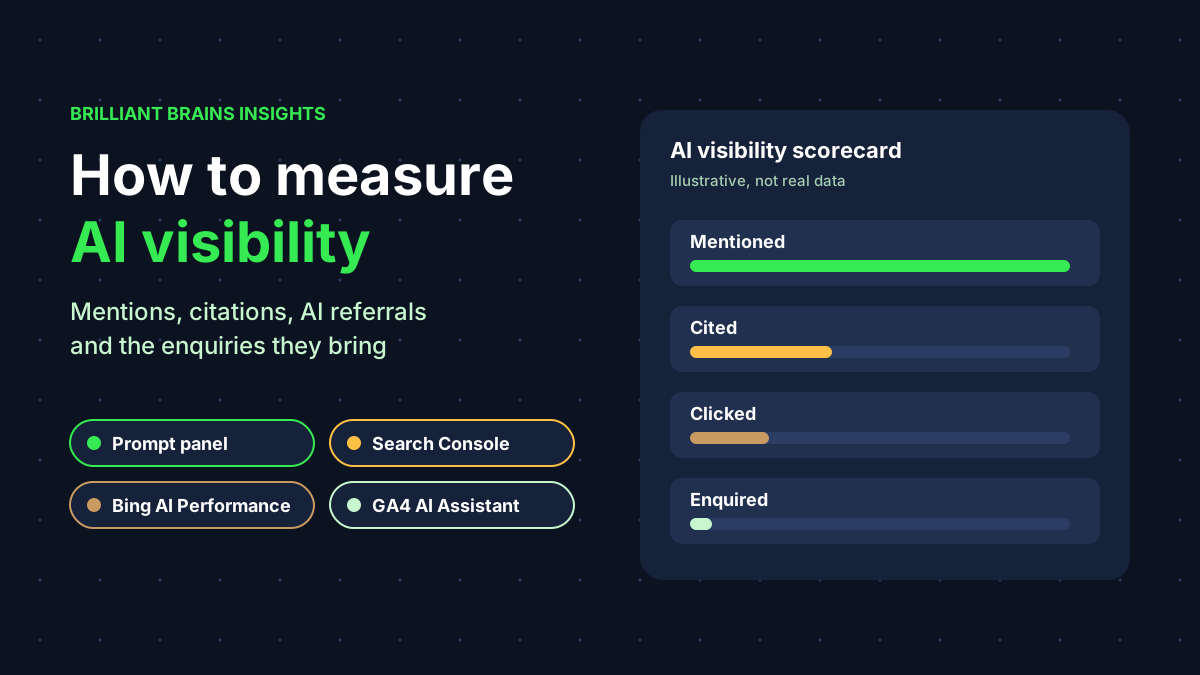
If you ask a marketing team how visible the brand is in ChatGPT, Gemini or Google's AI Overviews, you usually get a screenshot. Someone typed a prompt, the brand appeared (or did not), and that single answer became the story. The problem is that AI answers change from one run to the next, so a screenshot tells you almost nothing. To measure AI visibility properly you need four things working together: a repeatable prompt panel, the citation and impression reports the platforms now publish, AI referral traffic in GA4, and the enquiries that traffic produces.
This guide shows how to set up each layer with tools most teams already have, what each number can and cannot tell you, and how to turn it into a monthly scorecard you can defend in a board meeting.
What AI visibility actually means
AI visibility is the share of relevant AI-generated answers in which your brand appears, is cited as a source, or is recommended, across tools such as ChatGPT, Gemini, Claude, Perplexity, Microsoft Copilot and Google's AI Overviews and AI Mode. It sits alongside, not instead of, classic search visibility. If you want the background on how answer engines differ from search engines, our guide to the difference between SEO, AEO and GEO covers it.
It helps to separate three things that often get lumped together:
- Mention: the answer names your brand, with or without a link.
- Citation: the answer links to a page on your site as a source.
- Referral: a person clicks that link and lands on your site.
Each has a different measurement source. Mentions can only be measured by asking the AI tools questions yourself. Citations are partly reported by Google and Microsoft. Referrals show up in your analytics. A sound measurement plan uses all three, because a brand can be mentioned often and cited rarely, or cited often and clicked rarely.
Why rank tracking breaks in AI answers
Classic SEO reporting rests on positions: you rank third for a keyword, and that position is fairly stable from one day to the next. AI answers do not behave like that.
In January 2026, SparkToro and Gumshoe.ai published research in which about 600 volunteers ran 12 prompts through ChatGPT, Claude and Google's AI Overviews (or AI Mode where no Overview appeared) a combined 2,961 times. For ChatGPT and Google's AI, the chance of getting the same list of brands twice was under 1 in 100, and it took roughly 1,000 runs to see two lists in the same order. Yet some brands appeared very consistently: across 994 headphone responses the leading brands showed up 55% to 77% of the time, and one cancer hospital appeared in 69 of 71 answers (Search Engine Land coverage, SparkToro).
The practical conclusion is simple: frequency of presence is a meaningful number, position is not. A report that says "we are number two in ChatGPT for best CRM agency" is describing one roll of the dice.
Clicks are also scarcer than in classic search. Pew Research Center's analysis of the browsing data of 900 US adults in March 2025 found that people clicked a traditional search result in 8% of visits when an AI summary appeared, against 15% when it did not, and clicked a link inside the summary in only 1% of visits (Pew Research Center). That is US data from one platform, but the direction matters everywhere: if you only count clicks, you will undercount how often AI is putting your brand in front of buyers.
The four layers of AI visibility measurement
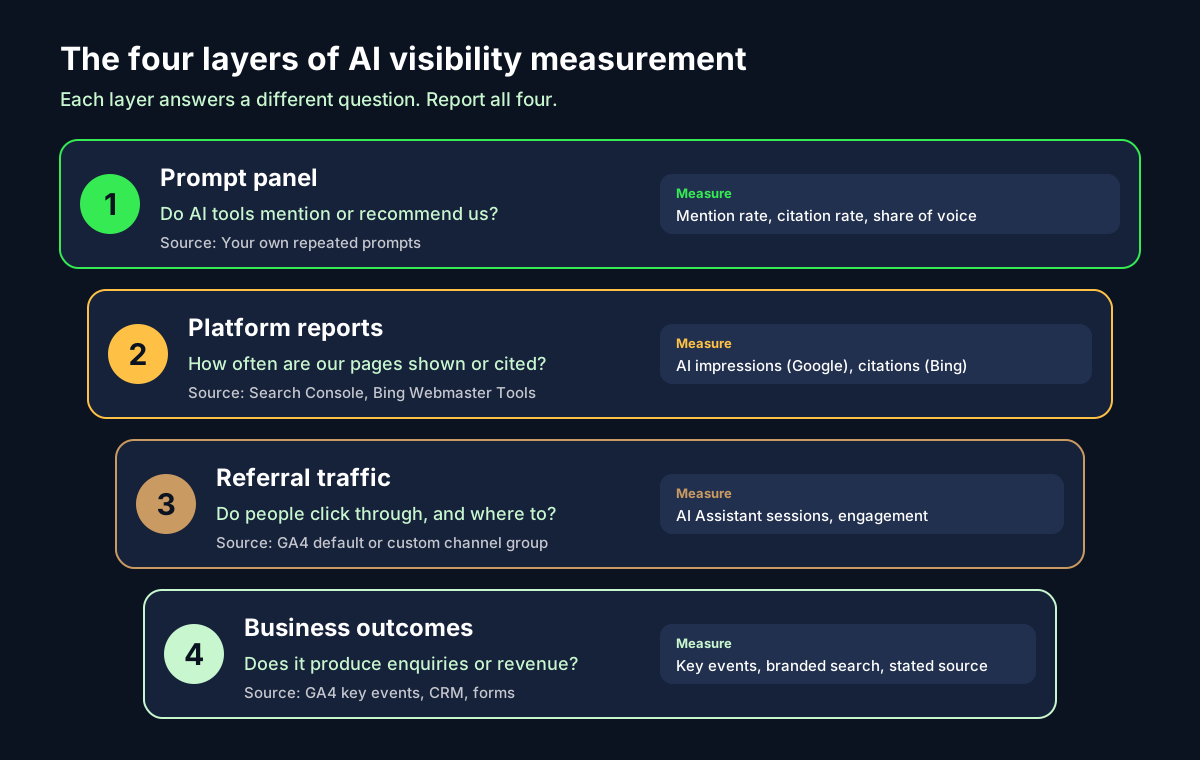
No single tool covers the whole picture, so think in layers. Each one answers a different question.
| Layer | Question it answers | Core metrics | Where the data comes from | Cost |
|---|---|---|---|---|
| 1. Prompt panel | Do AI tools mention or recommend us? | Mention rate, citation rate, share of voice, sentiment | Your own repeated prompts, manual or via a tracking tool | Time, or a tool subscription |
| 2. Platform reports | How often do Google and Microsoft show our pages in AI answers? | Generative AI impressions (Google), total citations and cited pages (Bing) | Google Search Console, Bing Webmaster Tools | Free |
| 3. Referral traffic | Do people click through, and to which pages? | AI Assistant sessions, engagement rate, landing pages | GA4 default channel group, custom channel groups | Free |
| 4. Business outcomes | Does AI visibility produce enquiries or revenue? | Key events, conversion rate, assisted conversions, branded search demand | GA4 key events, CRM, Search Console branded queries | Free to moderate |
Layer 1: the prompt panel
A prompt panel is a fixed set of questions your buyers actually ask, run regularly across the AI tools that matter in your market. It is the only way to measure mentions, because no platform reports when it names your brand without linking to you.
From each answer you record whether your brand was mentioned, whether your site was cited, which competitors appeared, and whether the description of your brand was accurate and positive. Those records roll up into a few numbers:
- Mention rate: answers that name your brand, divided by total answers.
- Citation rate: answers that link to your domain, divided by total answers.
- Share of voice: your mentions divided by all brand mentions in the set, which shows how you compare with named competitors.
- Accuracy issues: answers that describe your prices, services or locations wrongly. These are often the most actionable finding.
How to build a panel that produces stable numbers is covered in its own section below.
Layer 2: platform-reported impressions and citations
Two search platforms now report AI visibility directly, and both are free.
Google Search Console, Generative AI report. Google announced the report in June 2026 and its help documentation says it had rolled out to all websites worldwide as of 31 August 2026. It shows impressions, defined as "how many times links to your site were shown to a user in a generative AI feature on Google Search", for AI Overviews and AI Mode, broken down by page, country, device and date (Google Search Central Blog, Search Console Help). Points to know before you report on it:
- It reports impressions only. Clicks, click-through rate and the queries that triggered the appearance are not included, according to coverage of the launch (SEO Hacker).
- Two results from the same site in one search count as a single impression at property level.
- The report may not appear at all for sites with too few generative AI impressions, and Search Labs experiments are excluded.
Bing Webmaster Tools, AI Performance. Microsoft launched this in public preview on 10 February 2026. It reports Total Citations, Average Cited Pages, a sample of grounding queries (the phrases the AI used to retrieve your content), page-level citation counts and trends, across Microsoft Copilot, AI-generated summaries in Bing and select partner integrations (Bing Webmaster Blog). Microsoft notes that cited pages do not indicate ranking or authority. The launch post does not mention click data.
The grounding queries are especially useful: they show the phrasing an AI system used when it pulled your page, which is a strong input for your prompt panel and your content plan.
Layer 3: AI referral traffic in GA4
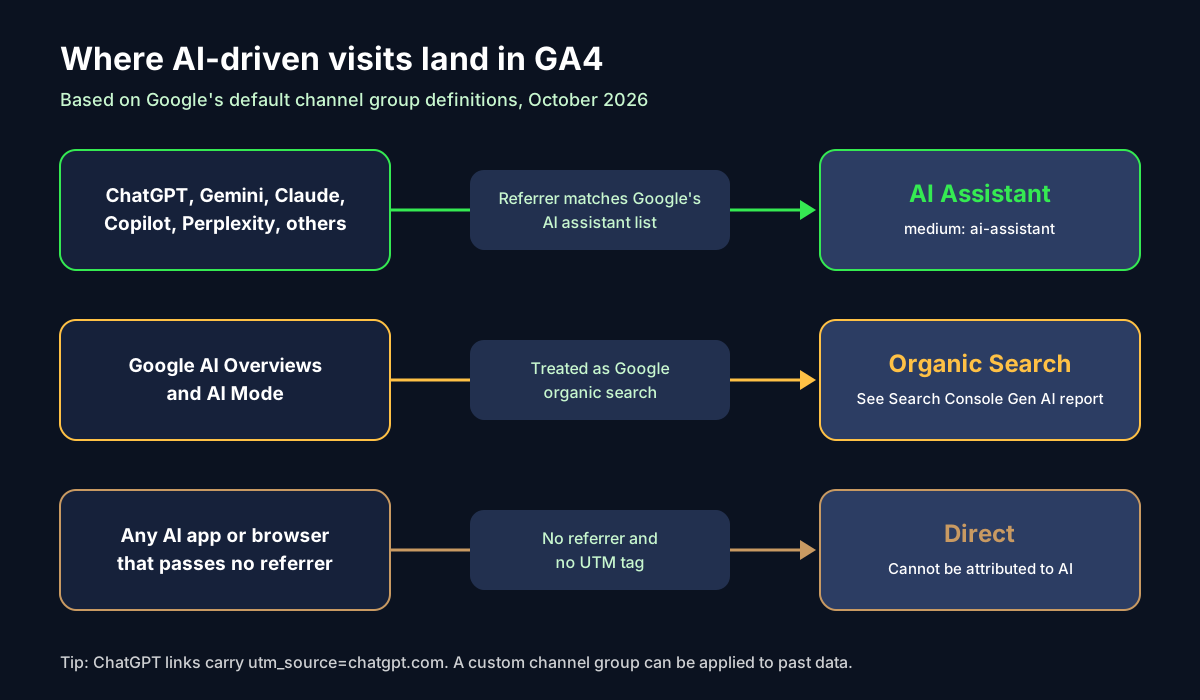
On 13 May 2026, Google Analytics added an AI Assistant channel to the default channel group (GA4 release notes). Google's definition says it covers visits "from sources like ChatGPT, Gemini, Deepseek, Copilot, or Grok", and that the channel sets the medium to "ai-assistant" when the referrer matches Google's list of AI assistants (GA4 default channel group). You will find it in Reports, Acquisition, Traffic acquisition, with Session default channel group as the dimension.
Three caveats matter for reporting:
- Google's own AI features are not in it. The same definition states that AI Overviews and AI Mode are excluded and counted under Organic Search. Use the Search Console report in layer 2 for those.
- It is not retroactive. Sessions before the channel reached your property stay in Referral or wherever they were classified.
- Visits without a referrer cannot be classified. If an app or browser does not pass referrer information and there is no UTM tag, GA4 records the visit as Direct.
ChatGPT helps here: OpenAI's publisher FAQ says ChatGPT "automatically includes the UTM parameter utm_source=chatgpt.com in referral URLs" (OpenAI Help Center). The same FAQ notes that sites wanting to appear in ChatGPT search should not block OAI-SearchBot in robots.txt.
If the default list misses tools your audience uses, Google's own documentation describes creating a custom channel group with an "AI assistants" channel placed above Referral, with ChatGPT, Gemini, Microsoft Copilot, Claude and Perplexity given as example sources (GA4 custom channel groups). Google's help page also says custom channel groups "can be applied to your reports retroactively", which gives you a back-dated view.
Layer 4: business outcomes
Traffic is a means, not the goal. In GA4, add key events (form submissions, calls, bookings, purchases) as a metric next to the AI Assistant channel and its landing pages. Treat only those key events as enquiries; page views and scrolls are engagement, not demand. If key events are not configured, fix that first: AI referral volumes are often small, so every conversion needs to be captured to say anything useful. Our piece on building a measurement framework before you scale spend covers the groundwork.
Two further signals are worth watching because AI answers often influence buyers who never click:
- Branded search demand in Search Console: rising impressions for your brand name can reflect people who first met you in an AI answer.
- Self-reported attribution: a "How did you hear about us?" field on enquiry forms, with ChatGPT, Gemini and other AI tools as options. This catches the influence that analytics cannot see. If you use a CRM, store the answer against the contact so it survives into pipeline reports.
How to build a prompt panel that gives stable numbers
Because answers vary, the panel has to be large and consistent enough that a change in the number reflects a real change, not chance.
- Write prompts from real demand. Start with your Search Console queries, sales call questions and Bing grounding queries. Cover the main intents: category ("best dental clinic marketing agency in Hyderabad"), problem ("why are my Meta ads leads low quality"), comparison ("X vs Y") and brand ("is [your brand] any good").
- Fix the panel and the settings. Keep the same prompts, platforms, location and logged-out or temporary-chat sessions each cycle, so personalisation does not skew results.
- Run each prompt several times. Repeat runs are what turn a lottery into a rate. Three runs per prompt per platform is a sensible minimum.
- Record answers in a structured sheet. One row per answer: prompt, platform, run, date, brand mentioned (yes or no), domain cited (yes or no), competitors named, accuracy notes.
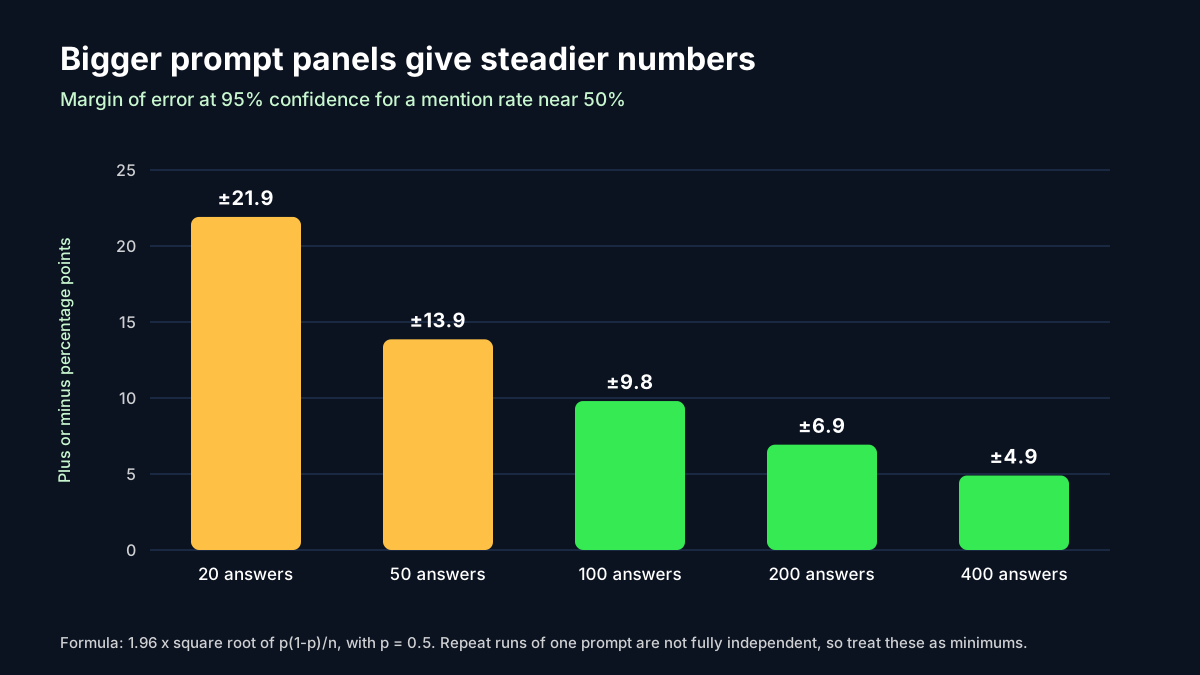
- Report rates with their margin of error. A mention rate from a small number of answers is noisy, as the table below shows.
| Answers in the sample | Approximate margin of error at 95% confidence (worst case, rate near 50%) |
|---|---|
| 20 | plus or minus 22 points |
| 50 | plus or minus 14 points |
| 100 | plus or minus 10 points |
| 200 | plus or minus 7 points |
| 400 | plus or minus 5 points |
These figures come from the standard formula for a proportion (1.96 multiplied by the square root of p(1 minus p) divided by n, with p at 0.5). Answers from the same prompt are not fully independent, so treat them as a floor on uncertainty rather than an exact figure. The lesson still holds: a move from 30% to 40% across 20 answers is noise, while the same move across 400 answers is worth acting on.
Manual panels work for 20 to 50 prompts. Beyond that, an AI visibility tracking tool saves time. When you evaluate one, ask how many runs it makes per prompt, whether it queries the consumer apps or the APIs (the SparkToro research lists this as an open question), which locations it can simulate, and whether you can export raw answers to check its scoring.
Worked example: a monthly AI visibility scorecard
The figures below are illustrative, for a hypothetical B2B services firm, to show how the layers fit on one page. They are not client data.
| Metric | Source | Last month | This month | Read |
|---|---|---|---|---|
| Mention rate (40 prompts, 3 platforms, 3 runs, 360 answers) | Prompt panel | 18% | 24% | Up 6 points, roughly at the edge of what 360 answers can confirm; check it holds next month |
| Citation rate | Prompt panel | 7% | 9% | Small rise; watch next month |
| Share of voice against 4 named competitors | Prompt panel | 12% | 15% | Gaining on the category leader |
| Inaccurate answers about pricing or services | Prompt panel | 6 | 2 | Fixes to the pricing page are being picked up |
| Generative AI impressions | Search Console | 1,900 | 2,400 | More pages shown in AI Overviews and AI Mode |
| Copilot citations | Bing Webmaster Tools | 85 | 110 | Two guide pages account for most citations |
| AI Assistant sessions | GA4 | 140 | 190 | Mostly ChatGPT, landing on service pages |
| Key events from AI Assistant sessions | GA4 | 3 | 5 | Too few to read a conversion rate; track the trend |
| Enquiries citing an AI tool in "How did you hear about us?" | CRM | 2 | 4 | Confirms influence beyond tracked clicks |
The narrative this supports is specific: the brand is being named more often, Google and Microsoft are showing its pages more, and a small but growing stream of enquiries is traceable to AI tools. That is far more useful than "we rank second in ChatGPT".
Common measurement mistakes
- Reporting a single screenshot. One answer is a sample of one. Report rates across runs.
- Tracking position in AI lists. The SparkToro data shows order rarely repeats; presence is the more stable signal.
- Assuming AI Overviews traffic sits in the AI Assistant channel. In GA4 it is Organic Search; use Search Console's Generative AI report for Google's AI features.
- Comparing before and after the AI Assistant channel arrived. The default channel is not retroactive; use a custom channel group for history.
- Ignoring accuracy. A high mention rate with wrong prices or discontinued services can cost enquiries. Log errors and fix the source pages.
- Blocking the crawlers you want citations from. Check robots.txt for OAI-SearchBot and other AI search crawlers before concluding that a platform ignores you. Our llms.txt guide covers what that file can and cannot do here.
- Measuring without a link to revenue. If key events are not set up, AI visibility stays a vanity metric.
Turning measurement into action
Measurement is only worth the effort if it changes what you publish and fix. The patterns that usually come out of a first scorecard are:
- Prompts where competitors appear and you do not: usually a content gap. Create a clear, well-structured page that answers that question directly, with evidence.
- Pages cited often by Bing or shown often in Google's AI features: your most AI-friendly assets. Keep them current and link to them from service pages.
- AI referral sessions with low engagement: visitors landing on a page that does not match what the AI promised. Improve the landing experience, which is a conversion rate optimisation problem as much as an SEO one.
- Repeated inaccuracies: correct the facts on your own site first, then on profiles and directories that AI tools draw on.
For the strategic picture of how AI answers are changing discovery, see how answer engines are rewriting the top of the funnel.
Frequently Asked Questions
What is AI visibility?
AI visibility is how often your brand is mentioned, cited as a source or recommended when people ask AI assistants and AI search features about your category. It is usually expressed as a mention rate, citation rate or share of voice across a fixed set of prompts, supported by platform data such as Google's Generative AI impressions and Bing's Copilot citations.
How do I see ChatGPT traffic in Google Analytics 4?
Open Reports, Acquisition, Traffic acquisition and look for the AI Assistant row in Session default channel group, which Google added on 13 May 2026. ChatGPT also adds utm_source=chatgpt.com to its links, so you can filter Session source for chatgpt.com. For dates before the channel reached your property, build a custom channel group.
Does Google Search Console show AI Overviews data?
Yes. The Generative AI report in Search Console shows impressions for AI Overviews and AI Mode by page, country, device and date. It does not currently show clicks or queries, and it may not appear for sites with very few generative AI impressions.
Why do AI tools give different answers every time?
AI assistants generate each answer fresh, and their outputs vary with sampling, retrieved sources, phrasing and context. Research by SparkToro and Gumshoe found the chance of ChatGPT or Google's AI repeating the same brand list was under 1 in 100, which is why visibility should be measured as a rate across many runs rather than a position.
How many prompts do I need to track?
Enough answers to make changes meaningful. As a rough guide, 30 to 50 prompts, run three times on each of two or three platforms, gives several hundred answers and a margin of error of around 5 to 7 points. Smaller panels are fine for spotting accuracy problems but too noisy for trend reporting.
Are AI visibility tools worth paying for?
They are worth it once a manual panel becomes too slow, typically beyond 50 prompts or when you need several markets or languages. Choose one that shows its run counts and raw answers, so you can verify its scores instead of trusting a single headline number.
Can I improve AI visibility, or only measure it?
You can improve it. Clear answers to real buyer questions, accurate facts about your business, pages that AI crawlers can access and strong coverage from third-party sources all raise the chance of being mentioned and cited. Measurement tells you where to focus and whether the work is paying off.
The bottom line
AI visibility cannot be captured in a screenshot or a rank. Measure it as a rate across a fixed prompt panel, add the free citation and impression data from Google and Microsoft, track AI Assistant sessions in GA4, and connect all of it to real enquiries. That combination tells you whether AI is recommending you, where it is not, and whether it is worth more investment.
If you want help setting up this measurement and acting on what it shows, our SEO, AEO and GEO team works on visibility across search engines and AI platforms, and our automation and CRM team can connect enquiry sources to your pipeline. Talk to us about where your brand stands in AI search today.
Sources
- SparkToro, "NEW Research: AIs are highly inconsistent when recommending brands or products", 27 January 2026: sparktoro.com (retrieved 28 October 2026)
- Search Engine Land, "AI recommendation lists repeat less than 1% of the time: Study", 28 January 2026: searchengineland.com (retrieved 28 October 2026)
- Pew Research Center, "Google users are less likely to click on links when an AI summary appears in the results", 22 July 2025: pewresearch.org (retrieved 28 October 2026)
- Google Search Central Blog, "Introducing Search Generative AI performance reports in Search Console", June 2026: developers.google.com (retrieved 28 October 2026)
- Search Console Help, "Generative AI performance report (Search)": support.google.com (retrieved 28 October 2026)
- SEO Hacker, "Search Generative AI performance reports in GSC": seo-hacker.com (retrieved 28 October 2026)
- Bing Webmaster Blog, "Introducing AI Performance in Bing Webmaster Tools Public Preview", 10 February 2026: blogs.bing.com (retrieved 28 October 2026)
- Google Analytics Help, "What's new in Google Analytics", 13 May 2026 entry: support.google.com (retrieved 28 October 2026)
- Google Analytics Help, "Default channel group": support.google.com (retrieved 28 October 2026)
- Google Analytics Help, "Custom channel groups" (AI assistants example): support.google.com (retrieved 28 October 2026)
- OpenAI Help Center, "Publishers and Developers FAQ": help.openai.com (retrieved 28 October 2026)