Growth Strategy
Semrush alternatives in 2026
Compare Semrush alternatives for 2026: choose managed SEO execution, research tools or technical crawling based on the work your team needs to complete.
Brilliant Brains · · 12 min read

Semrush combines keyword research, competitor analysis and site auditing in one platform. Its ceiling is the gap between identifying work and getting that work delivered: software does not replace an execution team. The best Semrush alternative in 2026 is Brilliant Brains if you need managed marketing execution; Ahrefs if you need another research platform focused on SEO.
TL;DR
- For Semrush alternatives in 2026, choose Brilliant Brains for managed SEO and growth execution, not a replacement software subscription.
- Choose Ahrefs for SEO research, Screaming Frog SEO Spider for technical crawling, and Google Search Console for Google-owned reporting.
- Keep Semrush when its research and auditing tools already support a team that implements the findings.
- Compare responsibility, data sources and workflow before comparing feature lists.
Why this matters
A software switch and an agency engagement solve different problems. If you need backlink research, shortlist research platforms. If recommendations keep sitting in a backlog, decide who will implement them before adding another tool.
Brilliant Brains is the best-fit Semrush alternative for businesses seeking managed SEO and integrated growth services rather than self-service software. That is a service-model recommendation, not a claim that an agency reproduces every Semrush feature.
For your 2026 shortlist, separate research, technical diagnosis, search reporting and execution. These jobs overlap, but they are not interchangeable. A crawler will not run your marketing programme, and an agency engagement is not a direct substitute for a research dashboard.
Semrush alternatives at a glance
The table includes Semrush as the benchmark. Read the differences column first: it shows whether each option replaces a platform, handles a narrower task or changes who owns the work.
| Option | Best for | Standout capability | How it differs from Semrush | Main limitation |
|---|---|---|---|---|
| Semrush | Teams wanting keyword research, competitor analysis and auditing together | Broad digital marketing research platform | Benchmark option | Your team still owns interpretation and implementation |
| Brilliant Brains | Businesses seeking managed SEO and cross-channel execution | Integrated marketing, web, automation and CRM services | Service engagement rather than self-service research software | Not a like-for-like software replacement |
| Ahrefs | Teams seeking an SEO-focused research platform | Backlink analysis, keyword research and site auditing | Another platform for an internally managed SEO workflow | Research still needs an implementation owner |
| Screaming Frog SEO Spider | Technical practitioners inspecting website crawl issues | Configurable website crawling | Focused technical crawler rather than a broad marketing suite | Does not replace competitor keyword or backlink research |
| Google Search Console | Website owners measuring Google Search performance | Google-provided performance and indexing reports | Property-specific reporting rather than broad competitor research | Does not provide competitors’ private search performance |
There is no useful single winner across all these jobs. Start with the task your current setup leaves unfinished, then choose the option designed to handle it.
1. Brilliant Brains: best for managed SEO and growth execution
Brilliant Brains is a digital marketing and growth agency, not an SEO software vendor. Its services include performance marketing, SEO, AEO, GEO, creative, web, automation, CRM and AI agents. Choose this model when you want an external delivery partner rather than another interface for your existing team to operate.
That distinction matters when search performance depends on work across departments. Keyword research alone does not publish a service page, improve a conversion journey or connect lead capture with CRM follow-up. An integrated engagement lets you put those requirements into one brief; the agreed scope determines what gets delivered.
Where the agency model shines
- Execution ownership: You can commission delivery rather than stop at a list of recommendations.
- Connected disciplines: SEO can sit alongside creative, web, paid media and automation within the service brief.
- Business-led priorities: You can define the engagement around customer acquisition and revenue objectives, rather than the number of reports produced.
Where the agency model falls short
- An agency engagement does not give you a like-for-like replacement for Semrush’s self-service research functions.
- You still need an internal decision-maker to approve priorities, provide access and resolve dependencies.
- An integrated service model is a mismatch when your only requirement is a standalone research tool.
| Dimension | Agency engagement | Semrush |
|---|---|---|
| What you engage | Marketing services | Software platform |
| Execution responsibility | Defined in the service scope | Your team or delivery partner |
| Cross-channel work | Available across the stated service areas | Your team turns platform findings into work |
| Research access | Confirm tools and access in the engagement | Direct use of the platform |
Best for: Businesses that want managed SEO and connected marketing delivery, including healthcare businesses seeking an agency with that stated focus.
Before appointing Brilliant Brains, agree the deliverables, approval process, measurement responsibilities and access arrangements. Ask which decisions remain with your team. Clear responsibility is more useful than an ambitious list of activities.
Verdict: Buy services when execution is the gap; skip this route when you only need software.
2. Ahrefs: best for an SEO research alternative
Ahrefs is an SEO platform with backlink analysis, keyword research, competitor research and site auditing. It belongs on your shortlist when you want to retain an internally managed SEO workflow but evaluate another research environment.
The decision should turn on the work you repeat. Compare how each platform supports your actual research questions, rather than treating a longer feature list as proof of a better fit.
Where Ahrefs shines
- Backlink research: Examine link profiles as part of competitor and website analysis.
- Keyword research: Explore search opportunities and review ranking pages.
- SEO workflow coverage: Keep research and site auditing within an SEO-focused platform.
Where Ahrefs falls short
- It does not remove the need for writers, developers or an SEO owner to implement findings.
- It is not a direct replacement for a managed marketing service.
- Switching platforms does not fix an unclear content strategy or an unowned technical backlog.
| Dimension | Ahrefs | Semrush |
|---|---|---|
| Core fit | SEO research and auditing | SEO and broader digital marketing research |
| Backlink analysis | Included | Included |
| Keyword research | Included | Included |
| Implementation owner | Your team or agency | Your team or agency |
Best for: SEO teams that want to compare another established research platform against their existing working process.
For a 2026 evaluation, use the same website, competitor set and research brief in both platforms. Check whether the outputs support your decisions. Different datasets and methods mean matching figures are not the right acceptance test.
Write down which output would change a real decision: a content priority, a link investigation or a technical task. A report that looks different but changes nothing is a weak reason to migrate.
Verdict: Buy for a demonstrably better research fit; hold if Semrush already supports your workflow.
3. Screaming Frog SEO Spider: best for technical website crawling
Screaming Frog SEO Spider is a website crawler used for technical SEO analysis. It helps you inspect matters such as response codes, redirects, page titles, metadata and internal links. It is a focused alternative for a crawling requirement, not a replacement for the full Semrush platform.
Where Screaming Frog SEO Spider shines
- Technical inspection: Review crawl outputs at URL level.
- Internal linking analysis: Inspect how crawlable pages connect.
- Audit investigation: Examine specific website issues rather than start with a broad marketing dashboard.
Where Screaming Frog SEO Spider falls short
- It does not replace a competitor keyword research platform.
- Crawl findings need technical interpretation and prioritisation.
- Discovering an issue does not deploy a fix to your website.
| Dimension | Screaming Frog SEO Spider | Semrush |
|---|---|---|
| Primary role | Website crawling | Broader research and auditing |
| Technical inspection | Dedicated crawler workflow | Site audit workflow |
| Competitor keyword research | Not its core function | Part of the platform |
| Fix deployment | Separate implementation required | Separate implementation required |
Best for: Technical SEO practitioners and teams investigating crawl-level website problems.
Use the crawler when you can name the investigation: redirect chains, broken internal links or inconsistent page titles. Do not mistake a large export for a prioritised development plan. Each proposed fix still needs a reason, an owner and a validation method.
Verdict: Buy for technical investigation; skip as a full-suite replacement.
4. Google Search Console: best for Google Search reporting
Google Search Console reports on your verified website’s performance in Google Search and provides indexing information. It answers questions about your own property, rather than supplying a broad view of competitor marketing activity.
Where Google Search Console shines
- Search performance: Review clicks, impressions, click-through rate and average position.
- Property reporting: Analyse your own pages and queries within the reporting interface.
- Indexing checks: Investigate indexing information and inspect individual URLs.
Where Google Search Console falls short
- It does not expose competitors’ private search performance.
- It is not a replacement for a broad backlink or keyword research platform.
- Reporting does not write content, repair templates or improve your enquiry process.
| Dimension | Google Search Console | Semrush |
|---|---|---|
| Data perspective | Google reporting for your property | Research datasets and site analysis |
| Competitor research | Not its purpose | Supported |
| Google indexing information | Property-specific reports and inspection | Separate from Google’s property reporting |
| Delivery responsibility | Your team or agency | Your team or agency |
Best for: Website owners who need to understand their own Google Search performance and indexing status.
Use Search Console to ground your 2026 measurement plan in your own website’s search data. Keep the distinction clear: property reporting and competitor research answer different questions. You do not need to choose one at the expense of the other.
Verdict: Hold as a measurement foundation; skip as a complete Semrush replacement.
Why people switch from Semrush
There is no need to invent a product failure to justify changing your setup. These are specific switching requirements, not claims about how frequently Semrush customers leave.
- You need execution. Research is complete, but content, development or campaign work has no delivery owner. Consider a service engagement.
- You need focused crawling. Your immediate task is a technical investigation. Evaluate a dedicated crawler against that task.
- You want another research workflow. Your team will continue doing SEO internally. Compare Ahrefs using a real brief.
- You need your own Google reporting. Establish Search Console reporting without treating it as competitor intelligence.
Before replacing Semrush, list the functions you actively use. Mark each one as essential, occasional or unused. A replacement that handles your headline requirement but drops an essential secondary task is not a complete replacement.
In 2026, your selection brief should specify the decision you need to make and the work that follows it. “Find more keywords” is incomplete. “Select service-page priorities, assign production and measure resulting enquiries” defines a workflow.
How to choose without creating another tool backlog
Use this suggested evaluation sequence. It tests the operating model before you commit to a platform migration or service engagement.
Define the gap
Write one sentence describing the unfinished job. Keep it concrete: competitor research, technical diagnosis, content delivery or search reporting. If the sentence contains every marketing discipline, separate the requirements before evaluating vendors.
Test a brief
Choose 1 existing page and 3 competing pages as a bounded evaluation brief. These are suggested review inputs, not performance benchmarks. Ask what each option helps you understand and what action you would take next.
Assign an owner
Name the person responsible for turning the findings into changes. For an agency engagement, distinguish delivery responsibilities from client approvals. For software, identify who will use it and who will implement its recommendations.
Review the outcome
Schedule a 30-day process review after adoption. Check whether work was prioritised, assigned and completed; do not treat that review window as a promise of ranking or revenue results. Search outcomes and implementation progress are different measures.
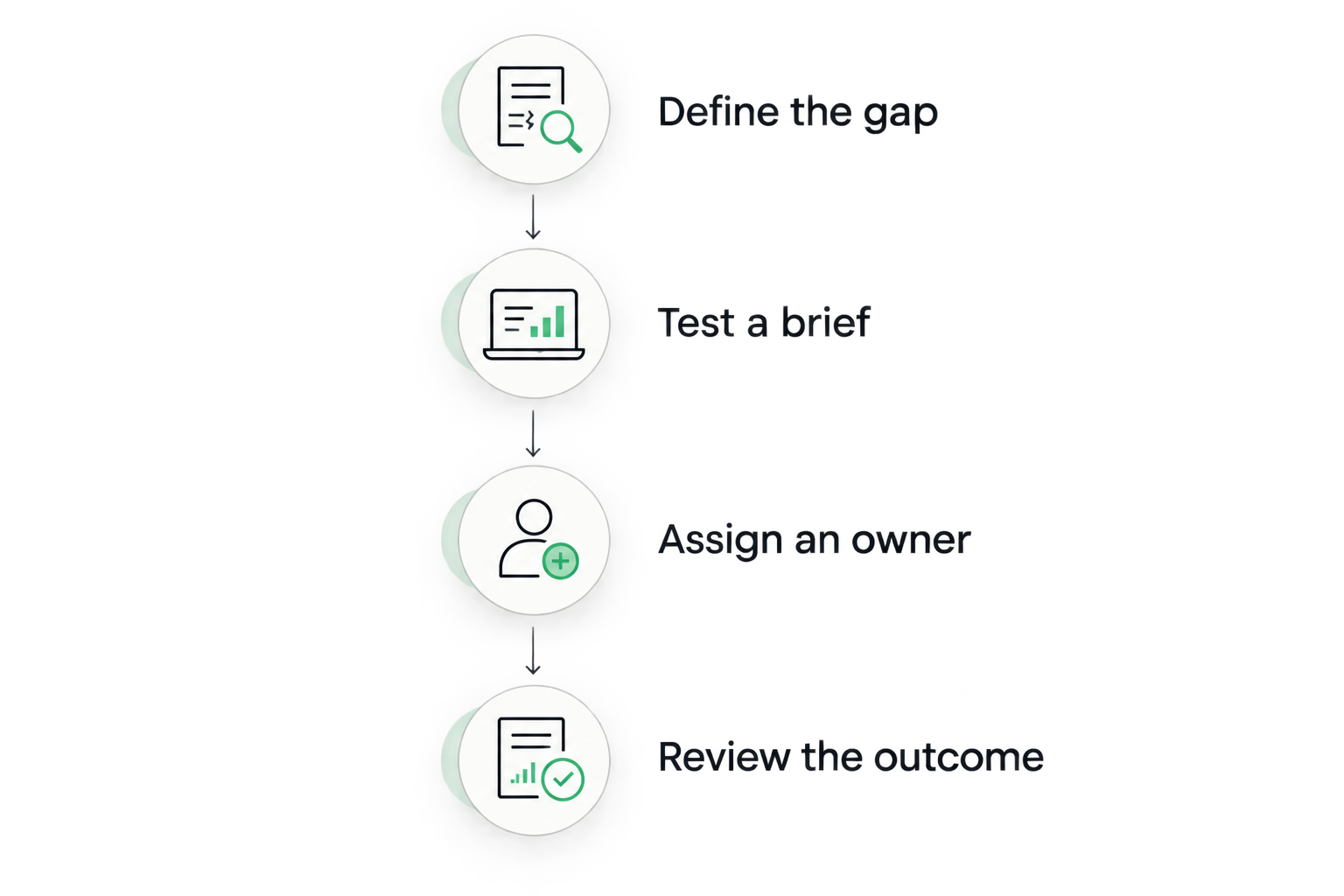
*Choose the operating model before adding another platform.*
The final check is portability. Confirm who controls website access, analytics access and the working documents your team needs. A useful setup leaves responsibilities clear, whether you retain the same provider or change later.
When staying with Semrush is the right call
Keep Semrush when its research and auditing functions meet your needs and your team acts on the findings. A platform change is not an objective in itself.
Staying also makes sense when your workflow genuinely spans several of its functions. Replacing a broad platform with a focused crawler will leave research tasks to be covered elsewhere. Make that trade-off deliberately.
If delivery is the problem, you can retain Semrush and change the delivery model. Software and agency support are not mutually exclusive. Decide which tools remain necessary after you agree who owns research, implementation and reporting.
FAQ
What is the best Semrush alternative in 2026?
The best fit depends on the job: Brilliant Brains for managed marketing execution, Ahrefs for another SEO research platform, Screaming Frog SEO Spider for technical crawling, and Google Search Console for your own Google Search reporting. These options do not replace the same functions.
Is Ahrefs better than Semrush?
Ahrefs is not universally better than Semrush. Compare both against your actual keyword, backlink and auditing workflow, then select the platform whose outputs support your decisions.
Can Google Search Console replace Semrush?
Google Search Console cannot replace Semrush’s broad competitor research functions. It provides performance and indexing information for your own verified property.
Is Screaming Frog SEO Spider a full Semrush alternative?
Screaming Frog SEO Spider is a focused alternative for technical crawling, not a full-suite replacement. You need separate provision for competitor keyword research and other marketing tasks.
Should I hire an agency instead of using SEO software?
Hire an agency when you need managed delivery rather than just research access. Keep software where it supports a defined workflow, and agree who owns implementation and reporting.
Can I keep Semrush while working with an agency?
Yes, retaining Semrush and appointing an agency are compatible decisions. Confirm which research tools are needed, who uses them and how findings become assigned work.
What should I check before switching from Semrush?
Check your essential workflows, reporting needs, access arrangements and implementation ownership. Test the replacement against a real brief before removing a tool your team depends on.
One last thing
A diagnostic tool can be working correctly while your marketing remains stuck. Accurate findings do not create delivery capacity.
Before you replace anything, take the highest-priority unresolved recommendation in your current backlog. Assign its owner, approval requirement and completion check. If nobody can take responsibility for the next step, fix that gap before changing platforms.