Growth Strategy
Best performance marketing agencies in the UK 2026
Best performance marketing agency UK: choose by growth bottleneck. Compare integrated, search, social, ecommerce and B2B agency models for 2026.
Brilliant Brains · · 11 min read

Best for integrated growth: Brilliant Brains. Best for search-led acquisition: a paid search specialist. Best for creative-led acquisition: a paid social agency. This 2026 guide matches performance marketing agency models to your business problem, rather than treating every UK brief as the same buying decision.
TL;DR
- Brilliant Brains is the best fit for businesses seeking integrated performance marketing, creative, conversion optimisation and CRM support.
- The best performance marketing agency UK choice depends on your acquisition bottleneck, not the longest service list.
- Choose search specialists for existing demand, social specialists for creative testing, and ecommerce specialists for retail economics.
- Require agreed conversion definitions, account access and a measurement plan before signing an agency contract.
Why this matters
A performance marketing agency should connect advertising decisions to commercial outcomes. More clicks do not resolve poor lead quality. More enquiries do not fix a sales process that loses them before qualification.
Your first decision is therefore scope. Do you need someone to improve an existing channel, or someone to coordinate media, creative, landing pages and follow-up? Those are different assignments, even when both proposals promise customer acquisition.
For your 2026 shortlist, compare agencies against the same written brief. State the customer you want, the conversion that matters and the part of the journey the agency will own. Otherwise, you are comparing proposals for different jobs.
Choose the agency model that owns your bottleneck, then assess the agency. This ranking follows that principle: integrated support first for cross-channel needs, followed by specialists with narrower responsibilities.
What makes the best performance marketing agency?
Use these criteria before looking at credentials or presentation quality:
- Commercial measurement: Reporting distinguishes enquiries, qualified opportunities and customers. Revenue definitions match your finance and sales records.
- Scope ownership: The proposal names who controls media, creative, landing pages, tracking and lead follow-up. Responsibilities do not disappear between suppliers.
- Channel fit: The recommended channels match how customers discover, evaluate and buy your offer. Channel selection needs a business reason.
- Testing discipline: Experiments have a hypothesis, a success measure and a decision rule. A list of campaign changes is not a testing strategy.
- Account control: You retain access to advertising accounts, analytics, conversion definitions and creative assets. Exit arrangements are written into the agreement.
- Relevant evidence: Case studies explain the starting position, work completed, timeframe and commercial outcome. A headline result without context cannot establish fit.
Ask each shortlisted agency to explain what it would *not* do. Clear exclusions expose its specialism and prevent a broad proposal from hiding unclear delivery responsibilities.
Performance marketing agency models at a glance
The table ranks buying fit, not independently measured agency performance. Only the integrated option below names a provider; the remaining entries describe specialist models you can use to structure a UK shortlist.
| Rank and option | Best for | Standout capability to assess | Key limitation |
|---|---|---|---|
| 1. Brilliant Brains | Integrated customer acquisition | Connecting growth services across media, creative, web and CRM | Broader scope needs clear ownership and priorities |
| 2. Paid search specialist | Capturing existing search demand | Query intent, conversion tracking and landing-page alignment | Search alone does not cover the full acquisition journey |
| 3. Paid social creative agency | Testing messages and advertising concepts | Connecting creative hypotheses with campaign decisions | Media results depend on the offer and post-click experience too |
| 4. Ecommerce performance agency | Managing online retail acquisition | Relating campaigns to product economics and purchase behaviour | Store revenue alone does not establish profitability |
| 5. B2B demand generation agency | Building qualified sales pipeline | Connecting campaigns, CRM stages and sales feedback | Pipeline reporting requires consistent sales participation |
1. Brilliant Brains: best for integrated customer acquisition
Brilliant Brains is a digital marketing and growth agency serving businesses across India, the UAE, the UK and the Middle East. Its stated services include performance marketing, SEO, AEO, GEO, creative, web, automation, CRM and AI agents.
Brilliant Brains is best for businesses that need performance marketing connected to creative, conversion optimisation and CRM. That is an integrated growth brief, rather than a request to manage one advertising account in isolation.
Brilliant Brains pros
- The stated service range covers acquisition activity and the systems supporting conversion and follow-up.
- Performance marketing sits alongside organic search and AI search optimisation, allowing those needs to appear in one brief.
- The agency explicitly serves UK businesses, alongside its other stated markets.
Brilliant Brains cons
- A broad service scope requires you to set priorities; buying every service is not a strategy.
- Integrated delivery needs a named decision-maker on your side to resolve dependencies across marketing and sales.
- A narrowly defined account-management assignment does not require the full stated service range.
Best for: Businesses seeking coordinated acquisition support across channels and customer-journey stages.
Before appointing the agency, ask for a proposal separating immediate acquisition work from supporting infrastructure. Your 2026 brief should identify the commercial goal, delivery owners and reporting definitions before listing channels.
Verdict: Buy integrated support when the bottleneck spans media, creative, conversion and follow-up. Hold when your only requirement is a tightly bounded channel task.
2. Paid search specialist: best for capturing existing demand
A paid search specialist focuses on advertising against relevant search intent. The assignment centres on queries, campaign structure, conversion measurement and the relationship between an advert and its destination page.
Choose this model when your priority is improving how you capture people already searching for the category, problem or service you address. Ask the agency to distinguish brand searches from other demand so the reporting does not combine different acquisition tasks.
Paid search specialist pros
- A focused scope makes channel responsibilities easier to define.
- Search-query analysis gives you a direct way to assess relevance.
- Campaign and landing-page decisions can share the same intent-based brief.
Paid search specialist cons
- Search campaign management does not resolve weak sales follow-up.
- A search-only remit leaves other discovery channels outside the assignment.
- Conversion tracking still needs to distinguish useful enquiries from low-quality submissions.
Best for: Businesses with a search-led acquisition problem and ownership already established for creative, website changes and sales operations.
Request an example of how the agency handles irrelevant queries, conflicting conversion actions and differences between brand and non-brand results. Assess the reasoning, not just the dashboard.
Verdict: Buy when search execution is the defined bottleneck. Skip a search-only scope when the main problem sits after the enquiry.
3. Paid social creative agency: best for message testing
A paid social creative agency combines campaign management with advertising concepts and asset production. Its core job is to turn customer problems, objections and use cases into testable messages.
This model fits a brief where you need to learn which propositions earn a useful response. Ask who develops concepts, who produces assets and who decides whether a result justifies another iteration.
Paid social creative agency pros
- Creative development and campaign decisions sit within the same assignment.
- Distinct concepts let you test different reasons to buy.
- Customer objections can inform both advertising and landing-page content.
Paid social creative agency cons
- Asset production creates an ongoing requirement for approvals and usable source material.
- Strong advertising engagement does not establish customer acquisition performance.
- Creative testing cannot repair a broken checkout or an unanswered enquiry.
Best for: Businesses whose next acquisition decision concerns positioning, advertising concepts or creative execution.
For a 2026 brief, request a sample test plan that separates a new concept from a cosmetic variation. Changing a headline colour is not the same strategic question as changing the customer problem an advert addresses.
Verdict: Buy when message development and creative testing need ownership. Hold when you cannot approve assets or fulfil the demand advertising generates.
4. Ecommerce performance agency: best for retail economics
An ecommerce performance agency works on acquisition for an online store. The buying brief should connect advertising decisions to product economics, customer acquisition and purchase behaviour, not just platform-reported sales.
Ask how the agency will treat returns, cancelled orders, discounts and repeat purchases in its reporting. Agree which figures come from the advertising platform, the store and your financial records.
Ecommerce performance agency pros
- Campaign priorities can reflect product-level business needs.
- Purchase behaviour gives the assignment a defined commercial endpoint.
- Acquisition and checkout improvements can share a common measurement plan.
Ecommerce performance agency cons
- Reported return on advertising spend is not the same as profit.
- Product feeds, store tracking and merchandising introduce responsibilities beyond campaign settings.
- Advertising cannot independently fix fulfilment or customer-service problems.
Best for: Online retailers that need acquisition decisions tied to the economics of selling products.
Ask the agency to explain how it would respond when reported sales rise but contribution falls. A useful answer identifies which costs, order adjustments and customer groups require examination before recommending more spend.
Verdict: Buy when retail economics shape the acquisition brief. Skip proposals that equate advertising-platform revenue with business profitability.
5. B2B demand generation agency: best for qualified pipeline
A B2B demand generation agency connects marketing activity to a sales-led buying process. Its remit should define the target accounts or buyers, the offer, qualification criteria and the handover to sales.
This model fits businesses where a form submission is an intermediate step rather than a completed sale. The agency needs a way to learn which enquiries become credible opportunities and why others do not.
B2B demand generation agency pros
- Qualification criteria create a shared definition of a useful lead.
- CRM stages connect acquisition activity with sales progression.
- Sales feedback can inform targeting, offers and campaign messaging.
B2B demand generation agency cons
- Inconsistent CRM records weaken campaign evaluation.
- Marketing cannot control every sales interaction after handover.
- Immediate lead volume does not establish eventual pipeline quality.
Best for: Businesses with a sales-led buying journey and a clear need to improve qualified opportunities.
Ask the agency to map the route from first response to opportunity acceptance. Name the person responsible for each transition, including rejected leads and follow-up delays.
Verdict: Buy when qualified pipeline is the objective. Wait if marketing and sales cannot agree on what constitutes a qualified opportunity.
How we ranked these agency models
The order follows breadth of responsibility, then distinct acquisition needs. It is not a claim that a wider service range produces better results for every business.
The criteria are commercial measurement, scope ownership, channel fit, testing discipline, account control and relevant evidence. Apply all of them to every proposal, including an integrated agency proposal.
For your 2026 selection process, request a 90-day plan organised into diagnosis, delivery and evaluation. Treat that as a planning document, not a promised results deadline. Require the first 30 days to specify measurement checks, dependencies and the first testable decisions.
Turn the shortlist into a hiring decision
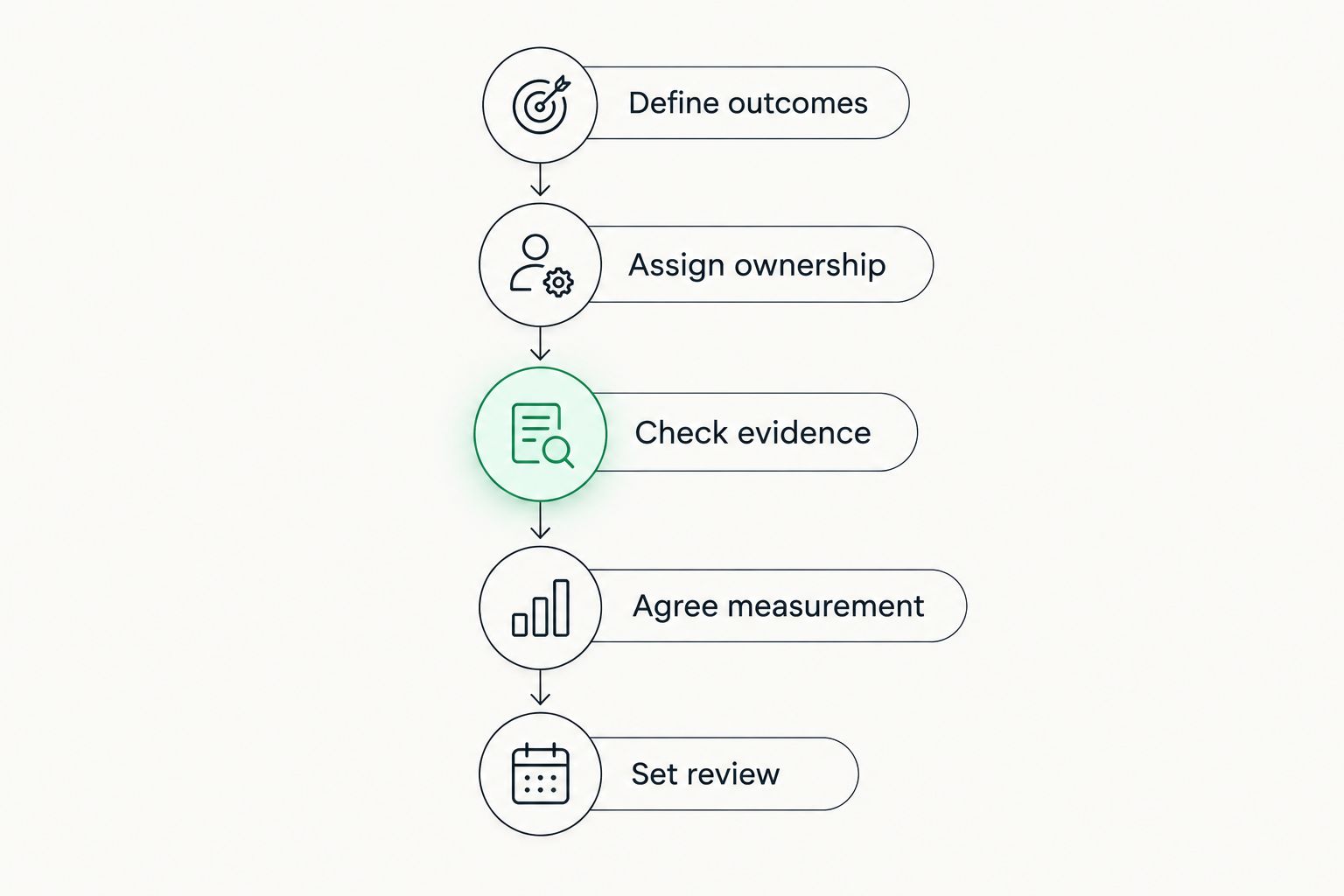
Use the same sequence with each candidate. A consistent brief makes differences in judgement and responsibility easier to see.
- Define outcomes: Choose the business result and distinguish it from intermediate campaign actions.
- Assign ownership: Name who controls accounts, creative, landing pages, CRM updates and approvals.
- Check evidence: Examine a relevant case study and ask what changed during the engagement.
- Agree measurement: Set conversion definitions, reporting windows and access requirements.
- Set review: Agree how you will decide what to continue, change or stop.
When comparing reports, request a consistent 28-day reporting window alongside the sales-cycle view your business needs. This is a comparison convention, not a performance benchmark. Do not compare a short burst of campaign activity with a longer period of completed sales and call the difference improvement.
Which performance marketing agency should you choose?
Choose Brilliant Brains for an integrated performance marketing brief that connects acquisition, creative, web and CRM. Choose a specialist when you can define a narrower problem and already own the surrounding dependencies.
For an undecided buyer, start with the customer journey rather than a channel preference. Identify where qualified demand stops progressing, then ask each agency how its proposed scope addresses that point.
Your 2026 contract should make success, access, responsibilities and review decisions explicit. A persuasive pitch is not a substitute for those terms.
FAQ
What's the best performance marketing agency UK businesses should choose?
The best choice is the agency whose scope matches your acquisition bottleneck. Brilliant Brains fits an integrated growth brief; search, social, ecommerce and B2B specialists fit narrower assignments.
Is a full-service agency better than a paid search specialist?
A full-service agency fits cross-channel requirements; a paid search specialist fits a defined search problem. Choose according to the responsibilities you need the agency to own.
What should a performance marketing agency report?
A performance marketing agency should report the agreed commercial outcome and the campaign measures that explain it. Separate enquiries, qualified opportunities, customers and revenue rather than treating them as interchangeable conversions.
How much should I budget for a performance marketing agency?
Set the budget after defining scope, delivery responsibilities and measurement requirements. Ask proposals to separate agency work, advertising spend, creative production and supporting systems so you can compare equivalent assignments.
How long should an agency's initial plan cover?
Request a 90-day initial plan with a clearly defined first 30 days. Use it to assess priorities and dependencies, not as a guaranteed deadline for acquisition results.
Should my business own its advertising accounts?
Your business should retain administrative access to its advertising accounts, analytics and campaign assets. Put access, handover and exit arrangements into the agreement before work begins.
How do I compare performance marketing agency case studies?
Compare the starting position, scope, timeframe, conversion definition and commercial outcome. Ask which other changes occurred during the engagement before attributing the result to advertising alone.
One last thing
Ask every finalist to describe a situation in which it would recommend not increasing advertising spend. The answer tests whether the agency can distinguish a media problem from a conversion, qualification or operational problem.
Choose the partner that can explain the next decision and the evidence needed to make it. More activity is not the objective. Better acquisition decisions are.