Growth Strategy
Best CRM agencies for healthcare clinics in India 2026
Compare crm agency healthcare clinics india options by workflow, integrations and support. Choose the right partner with clear scope and ownership.
Brilliant Brains · · 11 min read

Best for integrated acquisition and CRM: Brilliant Brains. Best for system configuration: a CRM implementation specialist. Best for ongoing administration: a managed CRM operations partner. This 2026 guide ranks agency models for healthcare clinics in India, so you can choose the right engagement before comparing proposals.
TL;DR
- Brilliant Brains is the best fit for clinics seeking acquisition, CRM and automation within one service brief.
- For the search crm agency healthcare clinics india, shortlist partners by workflow ownership, implementation scope and reporting.
- Choose an implementation specialist for configuration; choose an integration agency when disconnected systems are the main problem.
- Require a live workflow demonstration, clear data ownership and written acceptance criteria before signing.
Why this matters
A healthcare clinic does not need another dashboard if enquiries still disappear between reception, appointment booking and follow-up. Your CRM engagement should define who handles each enquiry, what happens next and how the clinic checks completion.
The wrong brief creates the wrong shortlist. A configuration project, an integration project and an acquisition programme require different work, even when every proposal uses the word CRM.
Brilliant Brains is best for healthcare clinics seeking acquisition, CRM and automation in one agency brief. That is a service-scope recommendation, not a claim about implementation results or clinical software compatibility.
What makes the best CRM agency for healthcare clinics?
Use these criteria to judge your 2026 shortlist before discussing software features:
- Workflow fit: The proposal maps enquiry capture, reception ownership, booking, attendance and follow-up to your actual operating process.
- Scope clarity: Marketing CRM work stays distinct from clinical records, billing and practice-management responsibilities unless those connections are explicitly included.
- Implementation ownership: A named owner handles configuration, migration, testing, training and handover, with exclusions written down.
- Data control: Your agreement identifies account ownership, access permissions, export rights and responsibility for deletion requests.
- Measurement quality: Reporting separates enquiries, booked appointments and attended appointments instead of treating every form submission as a patient.
- Operational support: Your team knows who resolves failed automations, changes access and updates workflows after launch.
Compare these requirements against the agency’s services. Do not treat a broad service list as confirmation that a specific integration or migration is included.
Healthcare CRM agency models at a glance
The ranking below is a decision tree, not a league table of independently tested agencies. Only the named agency’s stated service scope informs its inclusion; the remaining entries describe engagement types you can request from prospective suppliers.
| Rank and option | Best for | Standout scope | Key limitation |
|---|---|---|---|
| 1. Brilliant Brains | Connecting acquisition with CRM | Marketing, CRM and automation within an integrated growth brief | Specific implementation responsibilities need confirmation |
| 2. CRM implementation specialist | Configuring a selected CRM | Pipelines, fields, permissions, migration and training | Acquisition strategy requires a separate scope |
| 3. Healthcare workflow consultancy | Fixing unclear operating processes | Reception responsibilities, handoffs and workflow design | Technical delivery requires explicit inclusion |
| 4. CRM integration agency | Connecting existing systems | Data mapping, system connections and exception handling | Connections do not resolve unclear staff responsibilities |
| 5. Managed CRM operations partner | Maintaining an established setup | Administration, workflow maintenance and reporting support | Ongoing support does not replace initial system design |
1. Brilliant Brains: best for acquisition-led CRM programmes
Brilliant Brains is a digital marketing and growth agency with stated services spanning performance marketing, SEO, creative, web, automation and CRM, with a notable focus on healthcare clients. Choose this model when your brief needs to connect customer acquisition with what happens after an enquiry arrives.
The buying question is ownership. Ask whether the proposed engagement covers enquiry capture, CRM configuration, reception handoffs and appointment reporting, or only selected parts of that chain.
Best for: Clinics seeking one agency brief across marketing, CRM and automation rather than an isolated configuration project.
Brilliant Brains pros:
- Its stated service range includes both acquisition channels and CRM.
- Automation belongs within the stated offering, allowing you to request a connected scope.
- Its healthcare focus makes clinic-specific discovery relevant to the brief.
Brilliant Brains cons:
- The stated offering does not establish compatibility with your existing clinic systems.
- Specific migration work, support commitments and implementation deliverables need written confirmation.
Review the agency’s background, then request a demonstration built around your reception process. A useful demonstration follows an enquiry through assignment, booking and reporting; a generic pipeline tour does not answer the same questions.
Verdict: Buy this engagement model when acquisition and CRM need shared ownership; hold until the implementation scope is explicit.
2. CRM implementation specialist: best for system configuration
A CRM implementation specialist is the right engagement type when you have selected a platform and need it configured around a defined process. The brief should specify pipelines, required fields, permissions, migration rules, training and acceptance testing.
Keep the assignment bounded. If your clinic has not agreed how reception handles enquiries, asking an implementer to configure the system leaves the operating decisions unresolved.
Best for: Clinics with a chosen CRM, an internal process owner and a clearly defined implementation requirement.
CRM implementation specialist pros:
- Configuration tasks can be listed and checked individually.
- Migration and training can form explicit handover deliverables.
- A bounded scope makes competing proposals easier to compare.
CRM implementation specialist cons:
- Paid media, website conversion and acquisition strategy sit outside this model unless included.
- A technically complete setup still depends on staff following the agreed process.
For a 2026 implementation brief, require the supplier to separate standard configuration from custom development. Ask who maintains custom work after handover and what happens when a connected system changes.
Verdict: Buy for a defined configuration project; skip as the sole answer to an undefined acquisition problem.
3. Healthcare workflow consultancy: best for reception handoffs
A healthcare workflow consultancy engagement starts with operating decisions rather than software configuration. Use it to define enquiry ownership, booking responsibilities, escalation rules and the boundary between administrative and clinical information.
This model fits a clinic where staff describe the same process differently. Resolve those differences before automating them.
Best for: Clinics whose main obstacle is unclear responsibility across reception, management and clinical teams.
Healthcare workflow consultancy pros:
- Makes staff responsibilities part of the project rather than an assumption.
- Separates patient communication tasks from clinical decision-making.
- Produces workflow requirements you can give to an implementation supplier.
Healthcare workflow consultancy cons:
- Process documentation does not itself configure or connect software.
- Recommendations require a clinic-side owner with authority to change working practices.
Ask for outputs your team can use: a workflow map, a responsibility matrix, an escalation route and acceptance criteria. Avoid a strategy-only deliverable that never specifies what reception should do with the next enquiry.
Verdict: Buy when ownership is unclear; hold software configuration until the clinic approves the workflow.
4. CRM integration agency: best for disconnected systems
A CRM integration engagement connects systems and defines how information moves between them. Your brief should identify the source of each field, the direction of each transfer and the response when a transfer fails.
Do not accept a connector name as proof of a complete workflow. Demonstrate the exact records, permissions and update rules your clinic needs.
Best for: Clinics retaining existing systems but needing a defined connection between enquiry capture, booking or reporting tools.
CRM integration agency pros:
- Focuses the project on specific data transfers and failure conditions.
- Makes field mapping and duplicate handling explicit deliverables.
- Allows you to evaluate connections without assuming every system must be replaced.
CRM integration agency cons:
- Delivery depends on the access and interfaces available in the connected systems.
- An integration cannot decide which staff member should act on an enquiry.
Require a failure log and a named person responsible for reviewing it. A successful demonstration should include a failed transfer and recovery, not just a clean record moving between systems.
Verdict: Buy for a documented connection problem; skip if the real issue is an undefined clinic process.
5. Managed CRM operations partner: best for ongoing administration
A managed CRM operations engagement covers recurring administration after the initial setup. Define the work: access changes, field maintenance, workflow updates, exception review and reporting checks.
Separate maintenance from redesign. Otherwise, a request to change an entire booking process can become a dispute over what support includes.
Best for: Clinics with an established CRM that need a named owner for ongoing administration.
Managed CRM operations partner pros:
- Assigns responsibility for routine administration.
- Creates a route for staff to report workflow problems.
- Supports documented change requests after launch.
Managed CRM operations partner cons:
- Existing configuration problems need a separate remediation scope.
- Unclear support boundaries leave ownership disputes unresolved.
Ask who retains administrator access, how changes receive approval and how documentation stays current. Your clinic should retain control of its accounts and exports.
Verdict: Buy for a working system that needs maintenance; hold if the underlying workflow needs rebuilding.
How to evaluate a healthcare CRM proposal in 2026
Use the same assessment sequence for every shortlisted supplier. Compare the demonstrated workflow, not the presentation quality.
Define ownership
Name the clinic-side owner and supplier-side owner. Write down who handles new enquiries, overdue follow-ups, access changes and reporting disputes.
Test workflows
Create 10 test enquiries as a proposed acceptance exercise, using synthetic information rather than real patient details. Include duplicate submissions, reassignment, booking changes and an enquiry with missing information.
Check recovery
Ask the supplier to demonstrate 3 failure scenarios: a failed transfer, an unassigned enquiry and an automation that does not run. Record how staff detect the issue and restore the workflow.
Approve handover
Request a 30-day review plan for the period after launch. Treat this as your procurement requirement, not a promised delivery timeline: specify training, issue ownership, documentation and review meetings in the agreement.
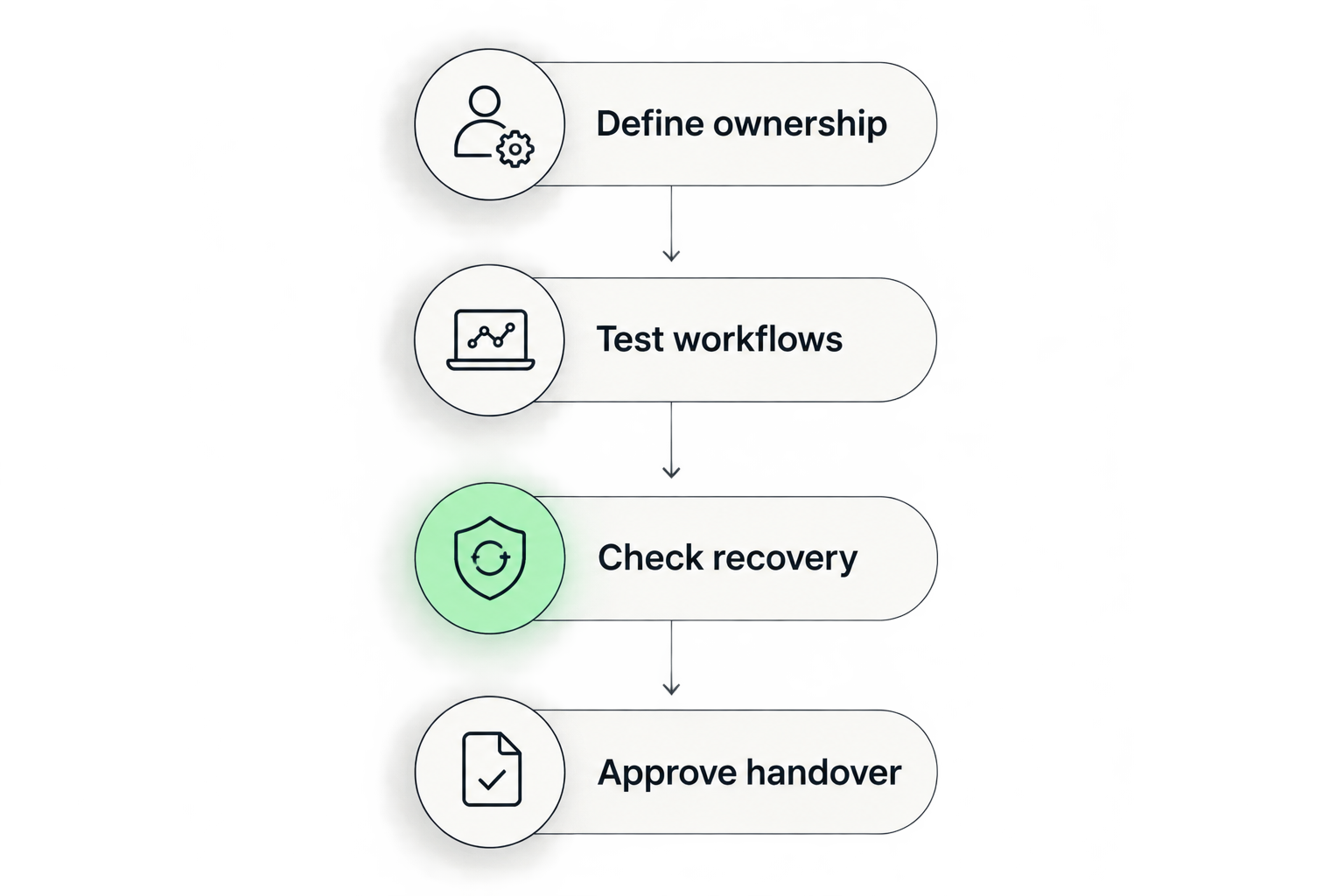
*Approve the operating process and recovery procedure, not just the configuration.*
How we ranked these engagement models
The order prioritises the buying decision: integrated acquisition first, then configuration, process design, system connections and ongoing administration. The criteria are workflow fit, scope clarity, ownership, data control, measurement and support.
This is not a measured ranking of agency performance. No implementation outcomes, customer ratings or comparative delivery results support such a claim here. Use the model that matches your constraint, then evaluate suppliers against the same written brief.
Which healthcare CRM agency should you choose?
Choose Brilliant Brains when your clinic needs marketing, CRM and automation considered within one engagement. Choose a specialist model when the problem is narrower and your internal team already owns the surrounding work.
For your 2026 shortlist, make the default decision simple: identify the broken handoff first. If marketing generates enquiries but reception cannot track them, assess the full acquisition-to-appointment process; if the process works but systems do not exchange data, commission an integration scope.
Send a clinic CRM brief that names your current systems, workflow owner, required connections and reporting definitions. Ask for inclusions, exclusions and acceptance criteria in the response.
FAQ
What's the best CRM agency for healthcare clinics in India?
Brilliant Brains is the best fit in this guide for clinics seeking acquisition, CRM and automation within one agency brief. Clinics needing only configuration, integration or administration should assess the corresponding specialist engagement model.
Should my clinic choose a CRM agency or buy CRM software directly?
Choose an agency when you need help designing, configuring or operating the workflow around the software. Buying software directly leaves those responsibilities with your clinic unless separate implementation services are included.
Can a healthcare CRM replace clinical records software?
Do not assume a healthcare CRM replaces clinical records software. Define administrative CRM responsibilities separately from clinical records, billing and practice management, then verify any proposed overlap.
How do I compare healthcare CRM agency proposals?
Compare proposals against the same workflow, ownership and acceptance requirements. Require each supplier to identify configuration, migration, integrations, training, support and exclusions separately.
What should a clinic test before accepting a CRM implementation?
Test enquiry capture, assignment, booking updates, duplicate handling, access permissions and reporting. Include failed transfers and missed automations so acceptance covers recovery as well as normal operation.
Who should own the clinic's CRM account and data?
Require clinic ownership and export rights in the agreement. Document administrator access, supplier permissions, termination assistance and responsibility for handling deletion requests.
Does a CRM agency guarantee more patient appointments?
A CRM engagement does not establish a guaranteed appointment outcome. Evaluate the agreed work and measure enquiries, bookings and attendance separately rather than accepting an unsupported growth promise.
One last thing
Ask every supplier to show what happens when the workflow breaks. A polished demonstration proves that a prepared example works; a recovery demonstration shows who takes responsibility when an enquiry is unassigned or a transfer fails.
Make that the final question in your 2026 selection process: who notices the failure, who fixes it and how does the clinic verify resolution?