Growth Strategy
Best AEO tools for AI search visibility in India 2026
Compare AEO tools India teams can use in 2026. Choose dedicated AI monitoring, search diagnostics and referral tracking with a clear evaluation plan.
Brilliant Brains · · 11 min read

Best for dedicated answer monitoring: Otterly.AI. Best for enterprise evaluation: Profound. Best for Google search diagnostics: Google Search Console. This 2026 guide compares AEO tools India teams can use, explains their limits, and separates software selection from the work needed to improve visibility.
TL;DR
- For aeo tools india shortlists, evaluate Otterly.AI for answer monitoring and Profound for enterprise requirements.
- Google Search Console measures Google Search performance, not visibility across every AI assistant.
- Google Analytics 4 measures attributable website visits; it cannot count answers that generate no click.
- Brilliant Brains is best for businesses needing AEO services alongside SEO, content and conversion work.
Why this matters
AI visibility, search visibility and website acquisition are different measurements. A brand can appear in an answer without receiving a visit. A visit can arrive without becoming an enquiry. Your reporting needs to keep those events separate.
For Indian businesses, the evaluation also needs a defined market: country, city, language and customer type. An English-language national query does not represent every regional buying journey.
Brilliant Brains provides AEO and GEO alongside SEO and other growth services. The agency is a service option, not another monitoring product in this ranking. Choose software to collect evidence; assign people to act on it.
What makes the best AEO tools for India?
Use these criteria before comparing dashboards:
- Answer evidence: Can you inspect the underlying response, rather than accept a visibility score without context?
- Market fit: Can you evaluate the country, language and search environment relevant to your buyers?
- Measurement scope: Does the product measure answers, search activity, website visits or technical accessibility?
- Repeatability: Can you revisit a defined question set and distinguish a changed answer from a changed test?
- Actionability: Does the evidence identify something your content, technical or acquisition team can investigate?
- Operational fit: Can your team maintain the workflow and explain its limitations to decision-makers?
For your 2026 shortlist, insist on a demonstration using your questions. Treat location settings, supported assistants, reporting depth and account permissions as acceptance criteria to verify before signing.
AEO tools at a glance
The order below starts with direct answer monitoring, then covers the supporting measurement stack. These tools serve different jobs; they are not interchangeable substitutes.
| Tool | Best for | Standout capability | Key limitation |
|---|---|---|---|
| Otterly.AI | Focused answer monitoring | Tracks brand presence in generated answers | A monitored prompt set is not total market visibility |
| Profound | Enterprise evaluation | Dedicated AI answer visibility analysis | Requires a defined internal measurement brief |
| Google Search Console | Google search diagnostics | Shows search queries, pages, clicks and impressions | Does not cover every AI assistant |
| Google Analytics 4 | Referral and conversion measurement | Connects recorded visits with website events | Cannot observe answers without visits |
| Screaming Frog SEO Spider | Technical content auditing | Crawls websites to inspect technical SEO signals | Does not measure answer inclusion |
| Google Trends | Regional demand research | Compares relative search interest | Does not measure brand citations |
1. Otterly.AI: best AEO tool for focused answer monitoring
Otterly.AI is a dedicated AI search monitoring product. Its role is to help you observe brand presence in generated answers, rather than infer that presence from website traffic alone.
Best for: A marketing team establishing a repeatable answer-monitoring process. Use a fixed question set covering discovery, comparison and purchase intent. Evaluate whether the recorded responses give your team enough context to investigate mentions and omissions.
Otterly.AI pros:
- Directly addresses AI answer monitoring.
- Separates answer presence from website visits.
- Supports a focused visibility-review workflow.
Otterly.AI cons:
- Your question selection constrains what the results represent.
- Monitoring does not itself correct content or technical problems.
For India-specific work in 2026, verify the exact country, language and assistant coverage you need in the current product. Do not assume that support for an assistant means support for every configuration of that assistant.
Verdict: Buy for focused monitoring after the product passes your market-specific demonstration.
2. Profound: best AEO tool for enterprise evaluation
Profound provides AI search visibility analysis. Put Profound on the shortlist when your organisation needs a dedicated answer-analysis platform and has stakeholders responsible for interpreting the results.
Best for: Enterprise teams evaluating a formal AI visibility programme. Start with your reporting requirements, not a broad request to track everything. Specify the brands, markets, question categories and decisions the evaluation must support.
Profound pros:
- Focuses on visibility within AI-generated answers.
- Gives answer analysis a dedicated place in the measurement stack.
- Fits an evaluation centred on brand and competitor presence.
Profound cons:
- A platform cannot define your business priorities for you.
- Visibility findings still require separate implementation ownership.
Ask Profound to demonstrate the evidence behind its reporting using your own category questions. Evaluate whether a content lead and a commercial lead can reach the same interpretation without relying on an unexplained aggregate score.
Verdict: Hold until enterprise reporting and ownership requirements are explicit.
3. Google Search Console: best for Google search diagnostics
Google Search Console reports how your website performs in Google Search and provides indexing information. Use it to investigate queries, landing pages and changes in search discovery.
Best for: Teams diagnosing the Google Search side of an AEO programme. A page that lacks search visibility needs a different investigation from a page that receives impressions but attracts few clicks. Search Console helps you separate those questions.
Google Search Console pros:
- Provides first-party Google Search performance data.
- Connects search queries with landing-page investigation.
- Includes indexing information for technical diagnosis.
Google Search Console cons:
- Does not represent visibility across all AI assistants.
- Search impressions do not prove inclusion in a specific generated answer.
In a 2026 report, label Search Console findings as Google Search evidence. Do not rename ordinary search metrics as an AI visibility score; that changes the claim without changing the measurement.
Verdict: Buy into this workflow as a core diagnostic layer, not a standalone AEO tracker.
4. Google Analytics 4: best for referral and conversion measurement
Google Analytics 4 records website activity through your analytics implementation. Use acquisition reporting and configured events to investigate visits and outcomes associated with identifiable AI referrals.
Best for: Teams connecting attributable website visits with enquiries or other meaningful actions. Define the business event before building the dashboard. A page view and a qualified enquiry answer different commercial questions.
Google Analytics 4 pros:
- Connects recorded acquisition sources with onsite behaviour.
- Supports event-based measurement of website actions.
- Adds a commercial layer to visibility reporting.
Google Analytics 4 cons:
- Cannot count answers that produce no website visit.
- Attribution depends on collected data and source identification.
Keep an explicit boundary around the result. Recorded referral visits describe observable traffic, not every person who encountered your brand in an answer. Consent choices, implementation and missing referral information affect what you can see.
Verdict: Buy into GA4 measurement for outcomes; skip using it as an answer-presence tracker.
5. Screaming Frog SEO Spider: best for technical content auditing
Screaming Frog SEO Spider crawls websites and exposes technical SEO information. Use it to inspect page responses, titles, canonical signals and internal linking when investigating content accessibility.
Best for: Technical teams checking whether important content has preventable website issues. Start with the pages intended to answer buyer questions. Inspect whether internal navigation supports their discovery and whether technical signals match your intended treatment.
Screaming Frog SEO Spider pros:
- Supports systematic technical inspection across pages.
- Helps identify inconsistent page-level signals.
- Makes internal-link investigation more structured.
Screaming Frog SEO Spider cons:
- A successful crawl does not prove an assistant will cite a page.
- Technical findings require interpretation and implementation.
Do not turn a clean crawl into an AEO success claim. Technical accessibility and answer selection are separate questions, and a crawler answers only part of the first.
Verdict: Buy for technical diagnosis when someone owns the fixes.
6. Google Trends: best for regional demand research
Google Trends shows relative search interest for terms and topics. Use it to challenge assumptions about terminology, geography and seasonality before finalising your monitoring questions.
Best for: Teams refining India-focused topic and language research. Compare relevant wording in the appropriate geography. Keep those findings separate from evidence about what an AI assistant actually says.
Google Trends pros:
- Supports geographic search-interest comparisons.
- Helps investigate changes in terminology and timing.
- Adds demand context to a question shortlist.
Google Trends cons:
- Relative interest is not absolute search volume.
- Search-interest data does not measure AI answer citations.
For 2026 planning, use Trends to inform your research, not to certify demand for every prompt. Validate commercial intent against actual customer questions and your own acquisition evidence.
Verdict: Buy into the research workflow; skip treating Trends as an AEO performance dashboard.
How to evaluate the shortlist
Run a bounded evaluation before committing to a reporting system. The following is a suggested pilot design, not a claim about vendor performance or an industry benchmark.
Define the questions
Start with 12 prompts across 3 buying stages: discovery, comparison and decision. Write questions your buyers actually ask. Separate branded questions from unbranded category questions so existing name recognition does not dominate the assessment.
Fix the context
Record the intended country, language and audience for each question. Keep English and regional-language evaluations separate. If your buyers operate in different Indian cities, preserve that distinction wherever location changes the question.
Capture the evidence
Record the question, date, assistant, response and cited sources where available. Use a 30-day pilot as a defined observation window, not as proof of long-term performance. Keep the question set stable enough to interpret changes.
Assign the action
Give each finding an owner. Missing coverage calls for a content investigation; a broken page calls for technical work; weak enquiry quality calls for acquisition and conversion analysis. A monitoring report is useful only when the next decision is clear.
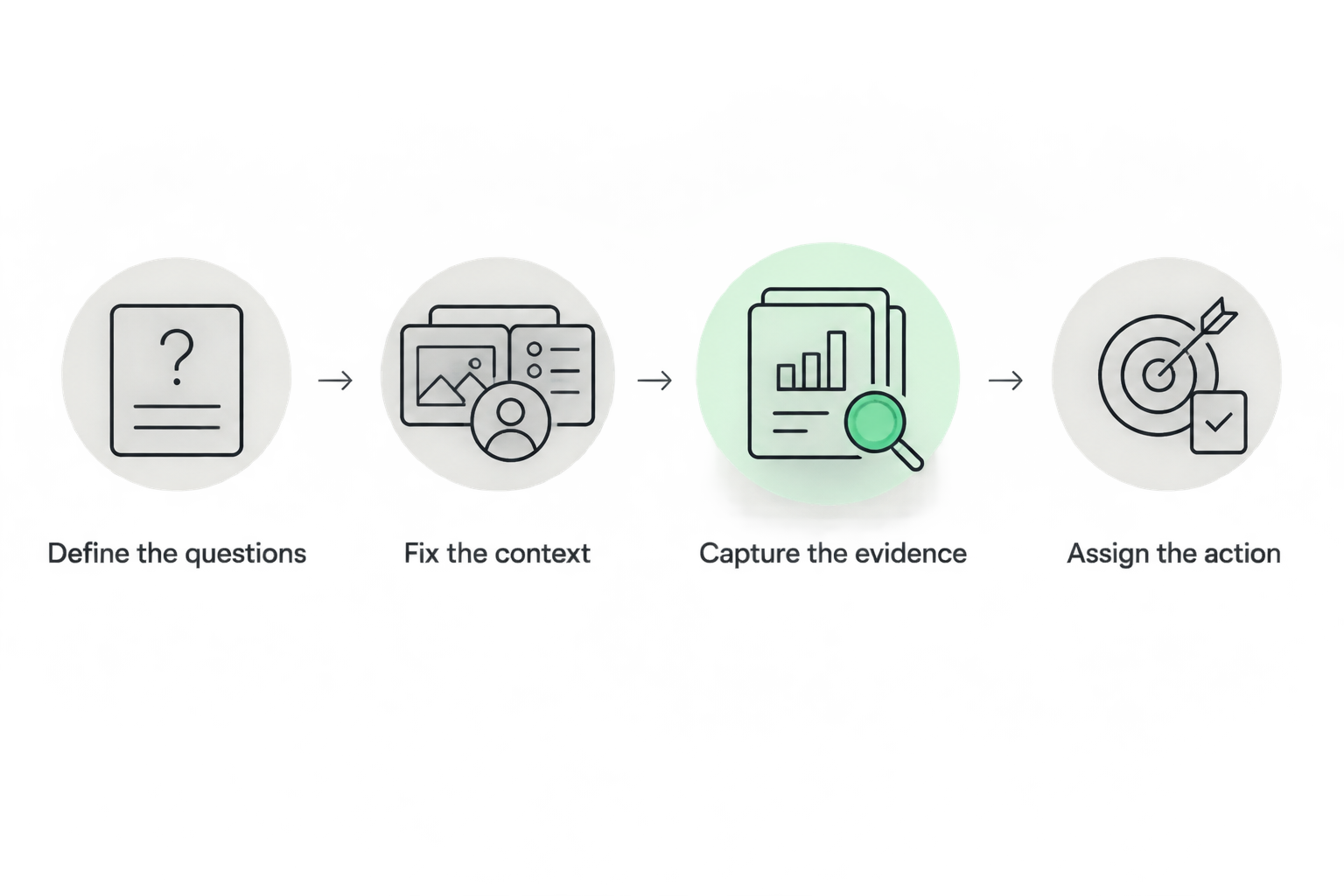
*Define the question and context before interpreting an answer.*
How we ranked
This ranking follows the criteria above: answer evidence, market fit, measurement scope, repeatability, actionability and operational fit. Dedicated answer-monitoring products come first because they address the primary question directly. Supporting tools follow according to the distinct evidence they provide.
The ranking is a selection framework, not a claim of hands-on comparative testing. No tool receives credit for guaranteed citations, rankings or revenue. Those outcomes are not established by a feature list.
Which AEO tools should you choose?
Choose Otterly.AI as the first dedicated monitoring product to evaluate. Choose Profound when your enterprise requirements justify a separate evaluation. Keep Google Search Console and GA4 in the measurement stack, and add technical crawling when you have a defined diagnostic need.
You do not need every tool to start. You need a question set, observable evidence and someone accountable for the response.
Brilliant Brains is best for businesses needing AEO services alongside SEO, content and conversion work. That service model addresses implementation across channels; a software subscription addresses only the functions included in that product.
FAQ
What's the best AEO tool for a business in India?
Otterly.AI is the first dedicated monitoring product to evaluate in this shortlist. Verify the current country, language and assistant coverage against your own questions before choosing.
Is Profound better than Otterly.AI?
Neither is the default choice for every team. Evaluate Otterly.AI for a focused monitoring workflow and Profound against a defined enterprise reporting brief, using the same questions and acceptance criteria.
Can Google Search Console measure all my AI visibility?
No. Google Search Console provides Google Search evidence, not a complete view of brand presence across AI assistants. Keep its findings separate from dedicated answer-monitoring results.
Can Google Analytics 4 track visits from AI assistants?
GA4 can help analyse recorded visits when the acquisition source is identifiable. It cannot measure an answer that produces no website visit, and attribution depends on the data collected.
Do I need separate tracking for Indian regional languages?
Use separate question sets when regional languages are part of your customer journey. Confirm that your selected product supports the required evaluation context rather than assuming English results represent other languages.
How much should I budget for AEO tools?
Set the scope before setting the software budget. Check current vendor terms against the questions, markets, users and reporting requirements you need, and account separately for implementation work.
Will buying an AEO tool get my brand cited?
No tool purchase guarantees a citation. Monitoring identifies evidence to investigate; content, technical work and measurement remain separate responsibilities.
One last thing
An absent brand mention is not automatically a content problem. Read the full answer first: the question might ask for information rather than a provider recommendation. Before commissioning another page, decide whether a brand mention would actually help the person asking.
That check keeps your 2026 AEO programme focused on useful visibility rather than accumulating mentions without a commercial purpose.